


Mary Slessor: The Little Scottish Woman Who Became Mother to a People
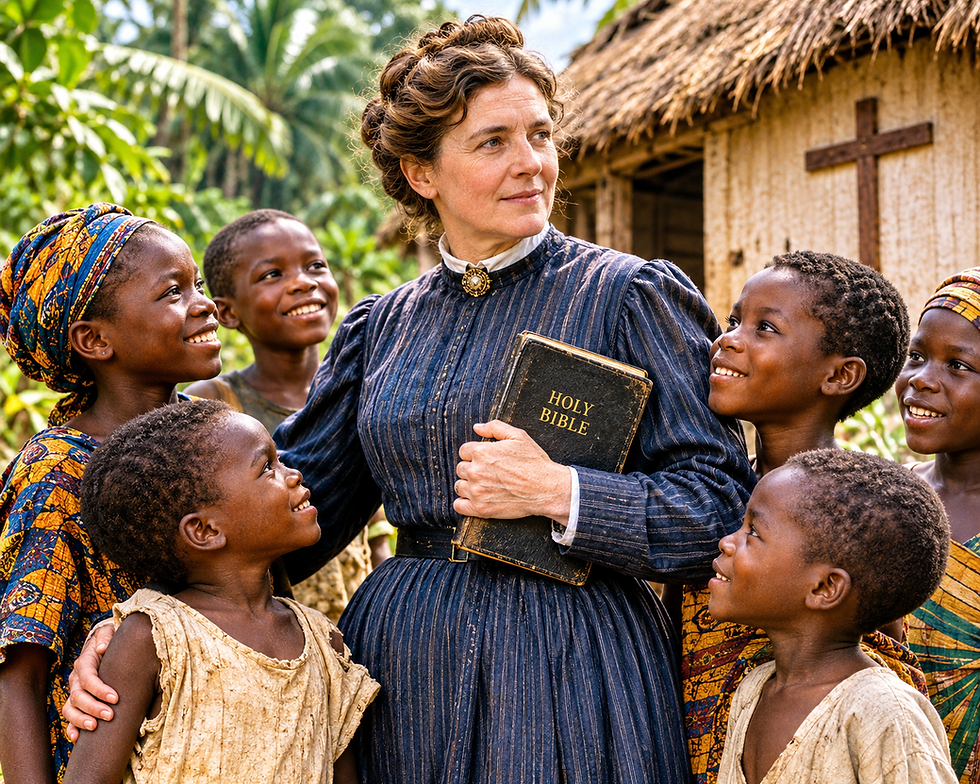
“I am ready to go anywhere, provided it be forward.” — Mary Slessor
In 1888, a small Scottish woman walked into the forests of West Africa with a Bible, a few possessions, and a determination that astonished even the missionaries who knew her.
She was forty years old.
She had already endured years of fever, homesickness, and exhausting work in the mission stations along the Calabar River in what is now southeastern Nigeria.
was not particularly strong.
She was not wealthy.
She had no husband or family to protect her.
And she was going somewhere other missionaries had been unwilling to go.
Her destination was Okoyong, an inland region where tribal rivalries, traditional religious practices, and violence made life dangerous. The people were suspicious of outsiders, and previous missionary efforts had met with little success.
Mary Slessor was going anyway.
She believed that Christ had called her, and that was enough.
A Factory Girl with a Mission
Mary Mitchell Slessor was born on December 2, 1848, near Aberdeen, Scotland, the second of seven children. Her father, Robert, was a shoemaker whose alcoholism brought hardship to the family. Her mother, Mary, was a deeply religious woman who maintained her Christian faith through years of poverty.
When the family moved to Dundee, Mary entered the textile mills at the age of eleven. Her mother also worked in the factories, and Mary's wages helped support the household.
It was a hard life. The noise and dust of the mills, the long hours, and the responsibilities of a struggling family left little room for childhood.
But her mother gave her something more valuable than an easy childhood. She gave her the Bible and a vision of Christian service.
The Slessor household regularly received the Missionary Record, a Presbyterian publication describing the work of missionaries around the world. Mary became fascinated by Africa, particularly the work of the Scottish mission in Calabar.
The stories of David Livingstone stirred her imagination. She and her brother had even played at being missionaries when they were children.
Her brother never made it to Africa. Mary would.
She also became active in the church's work among the poor children of Dundee. She taught, visited, and helped those whose circumstances were not very different from her own.
Her Christianity was not simply something she believed. It was something she wanted to put to work.
In 1875 she offered herself for missionary service. The following year, at twenty-seven, she was appointed by the United Presbyterian Church to serve in Calabar.
On August 6, 1876, she sailed for Africa.
The White Woman Who Learned to Speak
When Mary arrived at Duke Town in September 1876, she entered a world very different from the Scottish streets and factories she had known.
The tropical climate was oppressive. Disease was common. The work was demanding, and the missionary community was small.
She began by teaching, visiting women, helping with medical needs, and learning the language of the Efik people.
That last undertaking proved especially important.
Mary understood that she could not effectively serve people whose language she did not speak. She devoted herself to learning Efik, and eventually became so fluent that local people remarked that she had an Efik mouth.
She also began to understand the customs, relationships, and religious beliefs of the communities among whom she lived.
She encountered practices that deeply troubled her. Among them was the killing of newborn twins. In certain communities, twins were regarded with fear and associated with spiritual danger.
Babies could be abandoned or killed, and their mothers sometimes faced rejection.
Mary could not accept that children should die because of a superstition.
She began taking endangered babies into her own care.
Her home became a refuge. She adopted children, cared for them, and raised them as her own. Some were brought to her by people who had once considered the very existence of twins a source of terror.
This work was not accomplished by preaching alone. It required patience, personal relationships, and a willingness to live among the people she hoped to reach.
Mary's concern for children was part of a larger concern for women. She challenged practices that treated women as property and opposed the sacrifice of wives and servants when a chief died.
Her faith gave her no permission to look away from suffering.
Forward Into Okoyong
Mary's health repeatedly failed her. Fever and exhaustion forced her to return to Scotland for periods of recovery.
But each return to Africa brought her closer to the work she believed God had prepared for her.
She wanted to go inland.
The mission stations along the coast and rivers were important, but Mary believed that the Gospel must reach people who had little opportunity to hear it. She had become convinced that Okoyong was where she was needed.
The mission authorities were reluctant. The territory had a reputation for violence, and the prospect of sending a woman alone into the interior seemed unreasonable.
Mary persisted.
In 1888 she finally went to Ekenge in Okoyong, where she established herself among the people. She was accompanied by children she had taken into her family, and she would spend approximately fifteen years working in the region.
There she met Chief Edem and his sister, Ma Eme. Ma Eme became an important friend and ally. She helped Mary in her efforts to protect babies, women, and others in danger.
Mary did not establish her influence by standing apart from the community.
She lived among the people, learned their ways, attended their gatherings, and earned the right to be heard.
Her little house became a place where disputes were brought for settlement.
Chiefs, families, and ordinary people came to discuss their problems.
Mary listened, argued, advised, and sometimes intervened when violence threatened.
She was becoming known as Ma — mother.
A Missionary Who Became a Peacemaker
One of Mary's greatest contributions was her work in preventing violence between communities.
Blood feuds and tribal disputes could continue for generations. Human life was often lost over matters that might have been settled through negotiation.
Mary used her influence to bring opposing parties together. She was willing to walk into dangerous situations, confront powerful men, and insist that disputes be settled without further bloodshed.
Her work gradually attracted the attention of the British colonial administration. In 1892 she was appointed a government agent in Okoyong, giving her an official role in maintaining peace and administering justice.
It was an extraordinary development.
A former factory girl from Dundee had become an influential mediator in a region where European officials themselves had difficulty exercising authority.
Yet Mary did not see government appointment as the fulfillment of her life's ambition.
Her purpose remained Christian service.
She continued teaching, caring for children, visiting the sick, and establishing schools.
She worked to improve the position of women and to bring the message of Christ to communities beyond the established mission stations.
She also continued to struggle with illness. The fevers that had troubled her from her earliest days in Africa never entirely left her.
In 1905 she was appointed vice-president of a native court. Her responsibilities continued to grow, but she never abandoned the missionary work that had brought her to Africa.
Her influence was not the result of official authority alone. It had been earned through years of personal sacrifice.
The Hand of Christ
Mary Slessor died on January 13, 1915, in the land she had made her home.
She was sixty-six years old. She had spent nearly forty years in Africa, and her life had become inseparable from the people she served.
She had come from the poverty of Dundee with little more than her faith and her determination.
She left behind a legacy of children rescued, women defended, schools established, communities reconciled, and people introduced to the Christian Gospel.
The people who knew her called her Ma — mother to all.
Her life reminds us that Christian greatness is not measured by wealth, education, physical strength, or social position.
Paul wrote to the Corinthians:
“And God hath chosen the weak things of the world to confound the things which are mighty.” — 1 Corinthians 1:27 (KJV)
Mary Slessor might have seemed an unlikely candidate for a great missionary career. She was a factory girl, a woman of modest means, frequently ill, and often working without the protection or approval of those who might have preferred her to remain in safer surroundings.
But she had something that mattered more.
She believed that Christ was worth following, and she was willing to go forward when the way was difficult.
There is a final thought worth carrying away from her story.
Mary did not go to Africa because she believed herself to be strong enough for the task. She went because she believed God was strong enough.
And when she looked toward the forests of Okoyong, she did not ask whether the journey would be easy.
She said she was ready to go anywhere, provided it was forward.
That is a good direction for any Christian life.
**********************
1 It may not be on the mountain’s height
Or over the stormy sea,
It may not be at the battle’s front
My Lord will have need of me;
But if by a still, small voice He calls
To paths I do not know,
I’ll answer, dear Lord, with my hand in Thine,
I’ll go where You want me to go.
Refrain:
I’ll go where You want me to go, dear Lord,
O'er mountain or plain or sea;
I’ll say what you want me to say, dear Lord,
I’ll be what You want me to be.
2 Perhaps today there are loving words
Which Jesus would have me speak,
There may be now, in the paths of sin,
Some wand’rer whom I should seek;
O Savior, if Thou wilt be my Guide,
Tho dark and rugged the way,
My voice shall echo the message sweet,
I’ll say what You want me to say. [Refrain]
3 There’s surely somewhere a lowly place
In earth’s harvest fields so wide,
Where I may labor thru life’s short day
For Jesus the Crucified;
So, trusting my all unto Thy care--
I know Thou lovest me
I’ll do Thy will with a heart sincere,
I’ll be what You want me to be. [Refrain]
0


Comments