


And Can It Be: Charles Wesley and the Wonder of Amazing Love
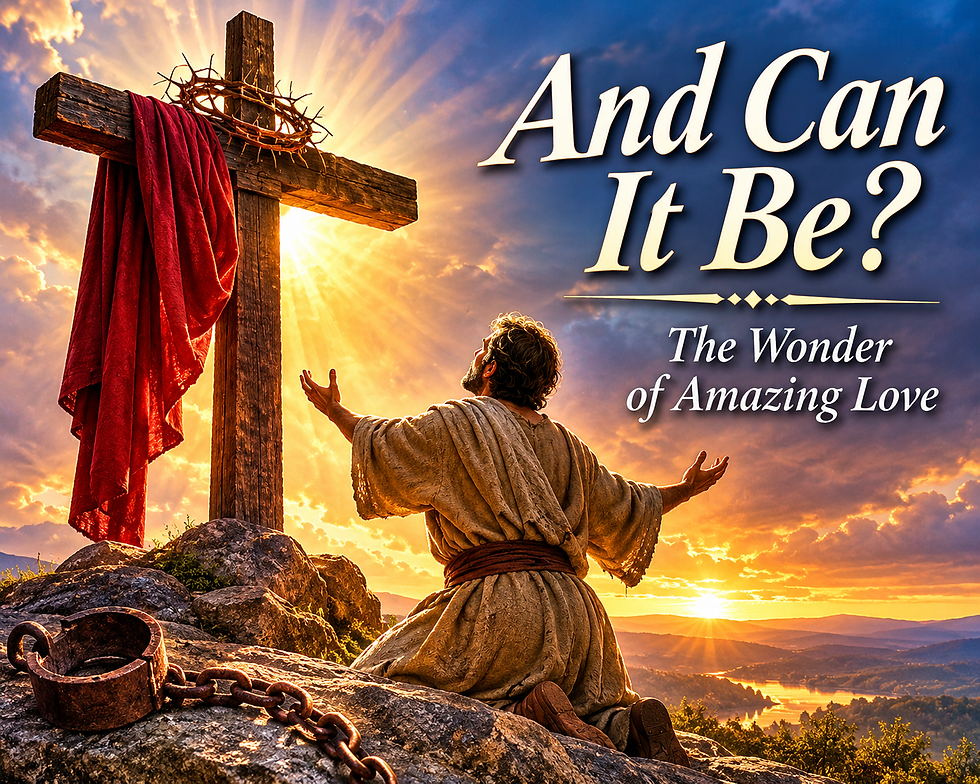
Great Hymns of the Christian Faith
There are questions that cannot be answered adequately with words. They can only be answered with wonder.
Consider the question Charles Wesley asked nearly three hundred years ago:
And can it be that I should gain an interest in the Savior's blood?
Think about what he was asking.
Could it really be true?
Could the Son of God love me so much that He would willingly die for me?
Could a sinner such as I receive the forgiveness, freedom, and eternal life that Christ purchased at Calvary?
Wesley did not ask this question as a theological exercise. He asked it as a man who had discovered something that changed his life forever.
And the hymn that came from that discovery has become one of the great declarations of Christian faith.
A brother's discovery before Aldersgate
Charles Wesley was born in 1707, the younger brother of John Wesley. Both men were educated at Oxford, both were ordained Anglican clergymen, and both were deeply concerned with living a disciplined Christian life.
They were serious men. They prayed, studied Scripture, fasted, and sought to serve God. Yet something was missing.
They knew the language of Christianity.
They understood its duties.
But Charles had not yet found the assurance of God's saving grace that he desperately needed.
In May 1738, Charles was seriously ill and staying at the home of John Bray, a humble London tradesman. During this period he was reading Martin Luther's commentary on Galatians and wrestling with the meaning of salvation through faith.
On May 21, Pentecost Sunday, Charles experienced a profound spiritual awakening.
He came to rest in the conviction that Christ had died for him and that he could receive salvation through faith.
There is a detail in this story that deserves to be remembered.
Charles's experience came three days before his brother John's famous Aldersgate experience on May 24, when John heard Luther's preface to Romans being read and wrote that his heart was strangely warmed.
We often tell the story of John Wesley and Aldersgate. But Charles had already discovered the assurance of God's grace.
And Charles began putting that discovery into poetry.
Within days, he was writing hymns that would give generations of Christians words for the wonder of salvation.
The question that became a hymn
The opening of "And Can It Be" is remarkable because it begins not with a declaration but with a question:
And can it be that I should gain/An interest in the Savior's blood?
The word interest is important. Wesley is asking whether he, personally, has a share in what Christ accomplished at Calvary.
Not merely whether Christ died for the world.
Not merely whether the Gospel is true.
Did He die for me?
The hymn then moves to the astonishing thought that Christ would die for someone who had no claim upon His love.
The answer is found in the character of God Himself.
Paul writes in Romans 5:8:
"But God commendeth his love toward us, in that, while we were yet sinners, Christ died for us."
That is the wonder Wesley is celebrating. God's love did not wait until we became worthy of it. Christ came to save us when we were helpless, sinful, and unable to rescue ourselves.
The prisoner who suddenly found the door open
Perhaps the most memorable image in the hymn comes in its fourth stanza.
Wesley pictures himself as a prisoner, bound in darkness, unable to escape.
Long my imprisoned spirit lay,/Fast bound in sin and nature's night;/Thine eye diffused a quickening ray,/I woke, the dungeon flamed with light;/My chains fell off, my heart was free,/I rose, went forth, and followed Thee.
This is more than beautiful poetry. It is a picture of the Gospel.
The prisoner does not break his own chains. He does not discover some hidden strength that enables him to escape.
Light comes from outside the prison.
Christ brings freedom.
The image reminds us of the apostle Paul's experience in Acts 16. When Paul and Silas were imprisoned in Philippi, an earthquake shook the prison, the doors opened, and the prisoners' chains were loosed.
But Wesley takes the picture deeper.
His prison is the bondage of sin, and his deliverance is the work of Christ.
The change is immediate and personal. The chains fall away. The prisoner becomes a free man.
And freedom has a destination: "I rose, went forth, and followed Thee."
That last phrase matters. Christian freedom is not freedom to live without God. It is freedom to belong to Him.
No condemnation!
The final stanza brings the hymn to a magnificent conclusion.
No condemnation now I dread,/Jesus, and all in Him, is mine!
Here Wesley takes us directly to Romans 8:1:
"There is therefore now no condemnation to them which are in Christ Jesus."
Notice the confidence. Wesley is no longer asking whether salvation is possible.
He is celebrating what Christ has accomplished.
The hymn reaches its climax with the picture of a redeemed sinner approaching the throne of God:
Bold I approach th' eternal throne,/And claim the crown, through Christ, my own.
What a transformation!
The man who began as a prisoner ends as an heir.
The sinner who had no claim upon God's favor is welcomed into His presence through Jesus Christ.
This is not human pride. It is confidence in the finished work of the Savior.
Hebrews 4:16 invites us to come boldly to the throne of grace, that we may obtain mercy and find grace to help in time of need.
Wesley understood that invitation.
He had discovered that the God before whom he once stood in fear was the God who had provided his salvation through His Son.
A hymn that has outlived its author
Charles Wesley wrote thousands of hymns during his lifetime. He died in 1788, leaving behind a treasury of Christian poetry that continues to enrich the Church.
"And Can It Be" first appeared in John Wesley's Psalms and Hymns in 1738. It was also published in the brothers' Hymns and Sacred Poems in 1739, where it carried the title "Free Grace."
There is another interesting detail about the hymn's history. The tune most commonly associated with it today, SAGINA, was composed by Thomas Campbell in 1825, decades after Charles Wesley's death. The words and music came together across generations, but the message remained unchanged.
The hymn has traveled far beyond the Methodist movement. Christians from many traditions have sung it, and its central question remains as powerful as when Wesley first put pen to paper.
And can it be?
Perhaps the greatest strength of this hymn is that it never allows us to become casual about salvation.
We can become accustomed to familiar Christian words.
We hear about the cross, the blood of Christ, forgiveness, grace, and eternal life so frequently that we may forget how astonishing these truths really are.
Charles Wesley did not forget.
He remembered what it meant to be a sinner who needed a Savior.
He remembered the darkness from which Christ had delivered him.
And he could scarcely believe the greatness of the love that had been extended to him.
That is why the hymn begins with a question.
And can it be?
Yes, Charles. It can be.
It is the very heart of the Gospel.
God loved us. Christ died for us.
The prison doors have been opened.
The chains have fallen away.
And through faith in Jesus Christ, we may approach the throne of God without fear.
We do not have to earn that love.
We do not have to purchase that forgiveness.
We receive it as the gift of God's amazing grace.
And perhaps the best way to finish is to sing the words once more, not merely as a familiar hymn, but as a personal testimony:
Amazing love! How can it be,That Thou, my God, shouldst die fpr me.
***************************
At Calvary
Years I spent in vanity and pride,
Caring not my Lord was crucified,
Knowing not it was for me He died
On Calvary.
o Mercy there was great, and grace was free;
Pardon there was multiplied to me;
There my burdened soul found liberty,
At Calvary.
o
By God's Word at last my sin I learned;
Then I trembled at the law I'd spurned,
Till my guilty soul imploring turned
To Calvary.
Now I've giv'n to Jesus everything,
Now I gladly own Him as my King,
Now my raptured soul can only sing
Of Calvary.
Oh, the love that drew salvation's plan!
Oh, the grace that brought it down to man!
Oh, the mighty gulf that God did span
At Calvary!
---- William Reed Newell, 1868-1956
Mercy unto you, and peace, and love, be multiplied. Jude 2


Comments