


God at Work in History #19Judges: Ehud — The Unexpected Deliverer
Scripture: Judges 3:12–30
When God's people cried out under oppression, the Lord raised up a deliverer from an unexpected place.
There are moments in history when the circumstances seem so hopeless that deliverance appears impossible. The enemy is powerful, the people are discouraged, and no obvious champion stands ready to help.
That was the situation in Israel during the days of the judges.
The people had forgotten the Lord. They had turned to the gods of the surrounding nations, and the consequences of their disobedience were becoming painfully real.
But God had not forgotten His people.
The Book of Judges now introduces us to a most unusual deliverer.
His name was Ehud, a man from the tribe of Benjamin.
His story is dramatic, unexpected, and a powerful reminder that God does not depend upon the obvious choices of men to accomplish His purposes.
The Oppressor Rises
Judges 3:12 tells us:
"And the children of Israel did evil again in the sight of the LORD: and the LORD strengthened Eglon the king of Moab against Israel."
Notice those words. The Lord strengthened Eglon.
Israel's troubles were not simply the result of an unfortunate political development. God was disciplining His people for their disobedience.
Eglon formed an alliance with the Ammonites and Amalekites, marched against Israel, and took possession of the City of Palms, generally identified with Jericho.
For eighteen years the Israelites lived under Moabite oppression.
The people who had once crossed the Jordan under Joshua's leadership now found themselves paying tribute to a foreign king.
It was a humiliating reversal.
Then, as so often happens in Judges, suffering brought the people to their senses.
"And when the children of Israel cried unto the LORD, the LORD raised them up a deliverer, Ehud the son of Gera, a Benjamite, a man lefthanded." (Judges 3:15, KJV)
The Lord heard their cry.
And He had chosen an unexpected man.
A Man with an Unusual Advantage
The Bible specifically tells us that Ehud was left-handed.
This detail is important to the story. In a society where right-handedness was the ordinary expectation, Ehud's left-handedness gave him an unusual advantage.
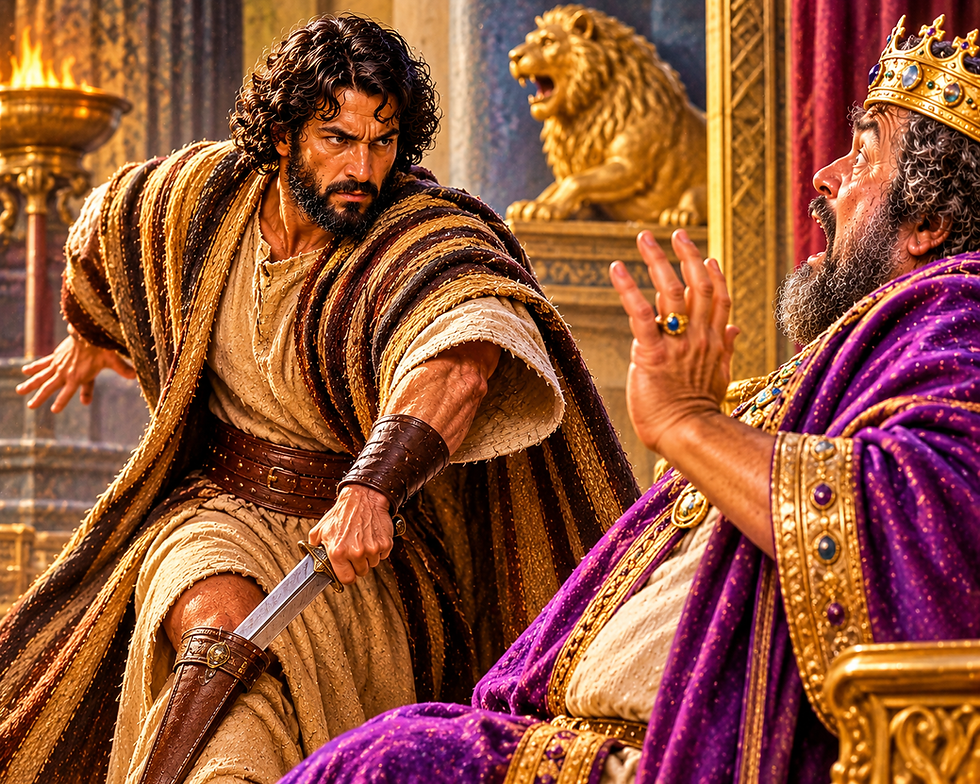
He prepared a short, double-edged sword, about a cubit in length, and strapped it beneath his clothing upon his right thigh.
Most people would have expected a weapon to be carried on the left side, ready for a right hand to draw it. Ehud's arrangement was different.
He was going to deliver Israel, but the enemy had no reason to suspect how.
Ehud was appointed to carry Israel's tribute to Eglon, the king of Moab.
The king was described as a very fat man. The detail may seem unnecessary, but it becomes important in the extraordinary events that follow.
Ehud delivered the tribute and sent away the men who had accompanied him.
Then he turned back.
He came to Eglon at the place of the carved images near Gilgal and announced:
"I have a secret errand unto thee, O king." (Judges 3:19)
The king dismissed his attendants.
Ehud now stood alone with the ruler who had oppressed Israel for eighteen years.
A Message from God
The next words are among the most memorable in the entire account.
"And Ehud said, I have a message from God unto thee. And he arose out of his seat." (Judges 3:20)
The king stood to receive the message.
Ehud reached with his left hand, drew the sword from his right thigh, and thrust it into Eglon.
The account is graphic, and Scripture does not soften the details. Eglon fell, and Ehud escaped through the porch, closing and locking the doors of the upper chamber behind him.
The king's servants returned, found the doors locked, and assumed their master was attending to his private needs.
They waited.
And waited.
Eventually their embarrassment gave way to concern. When they finally opened the doors, they discovered their king dead upon the floor.
Meanwhile, Ehud had escaped.
The Signal for Battle
Ehud did not simply flee to safety.
He returned to the Israelites and sounded the trumpet in the hill country of Ephraim.
Then he gave the people their marching orders:
"Follow after me: for the LORD hath delivered your enemies the Moabites into your hand." (Judges 3:28)
There is the heart of the story.
Ehud did not say that his clever plan had delivered Israel. He declared that the Lord had delivered their enemies into their hands.
The Israelites followed him, seized the fords of Jordan leading toward Moab, and prevented the enemy from escaping.
The Bible tells us that they slew about ten thousand Moabites, described as strong and valiant men, and not one escaped.
The victory was decisive.
The eighteen years of oppression came to an end.
"And the land had rest fourscore years." (Judges 3:30)
Eighty years!
For a generation after generation, Israel enjoyed peace.
What the Story Teaches Us
Ehud's story is not an invitation to imitate the violence of an ancient battlefield. It is a record of God's dealings with His covenant people during a difficult and often brutal period of their history.
But several truths stand out.
First, God hears the cries of His people.
Israel had brought its troubles upon itself through disobedience. Yet when the people cried out, the Lord did not turn away. He raised up a deliverer.
Second, God can use people whom others might overlook.
Ehud was not introduced as a great military commander or a celebrated national hero. He was simply a man chosen by God for a particular task.
His unusual characteristic became part of the means through which deliverance came.
Third, the victory belonged to God.
Ehud was the instrument, but the Lord was the deliverer. This distinction runs throughout the Book of Judges. Israel's hope was never ultimately in the personality or ability of its leaders. Its hope was in the God who continued to work in its history.
The Deliverer We Still Need
As we read the Book of Judges, we begin to recognize a pattern.
Israel sins. Israel suffers. Israel cries out. God raises a deliverer. The people receive relief.
But the pattern repeats.
Ehud could rescue Israel from Moabite oppression, but he could not cure the deeper problem in the hearts of the people.
The deliverance he brought lasted eighty years, but even that peace would eventually end.
The history of the judges points beyond itself.
We need more than temporary relief from our troubles.
We need a Savior who can deliver us from the power of sin and reconcile us to God.
For Christians, that Savior is Jesus Christ.
The judges were temporary deliverers, raised up for particular moments in Israel's history. Jesus is the eternal Savior, whose victory reaches beyond any earthly enemy and whose kingdom shall never end.
Ehud's story reminds us that God can bring deliverance from the most unexpected places.
The God who raised up an unlikely man in Israel is still sovereign over history.
And He has already provided the Deliverer whom the world most desperately needs.
Next in our series: Deborah — When a Woman Led Israel to victory.
*****************************
He is Able to Deliver Thee
’
Tis the grandest theme through the ages rung;
’Tis the grandest theme for a mortal tongue;
’Tis the grandest theme that the world e’er sung,
“Our God is able to deliver thee.”
Refrain:
He is able to deliver thee,
He is able to deliver thee;
Though by sin oppressed, go to Him for rest;
“Our God is able to deliver thee.”
’
Tis the grandest theme in the earth or main;
’Tis the grandest theme for a mortal strain;
’Tis the grandest theme, tell the world again,
“Our God is able to deliver thee.”
Tis the grandest theme, let the tidings roll,
To the guilty heart, to the sinful soul;
Look to God in faith, He will make thee whole,
“Our God is able to deliver thee.”
William A. Ogden, pub.1887
Wherefore he is able also to save them to the
uttermost that come unto God by him, seeing he
ever liveth to make intercession for them. Heb.7:25



Comments