


GENESIS: Part 1 — The Primeval History Interlude: Noah, Daniel, and Job — Three Men Who Could Not Save a Nation
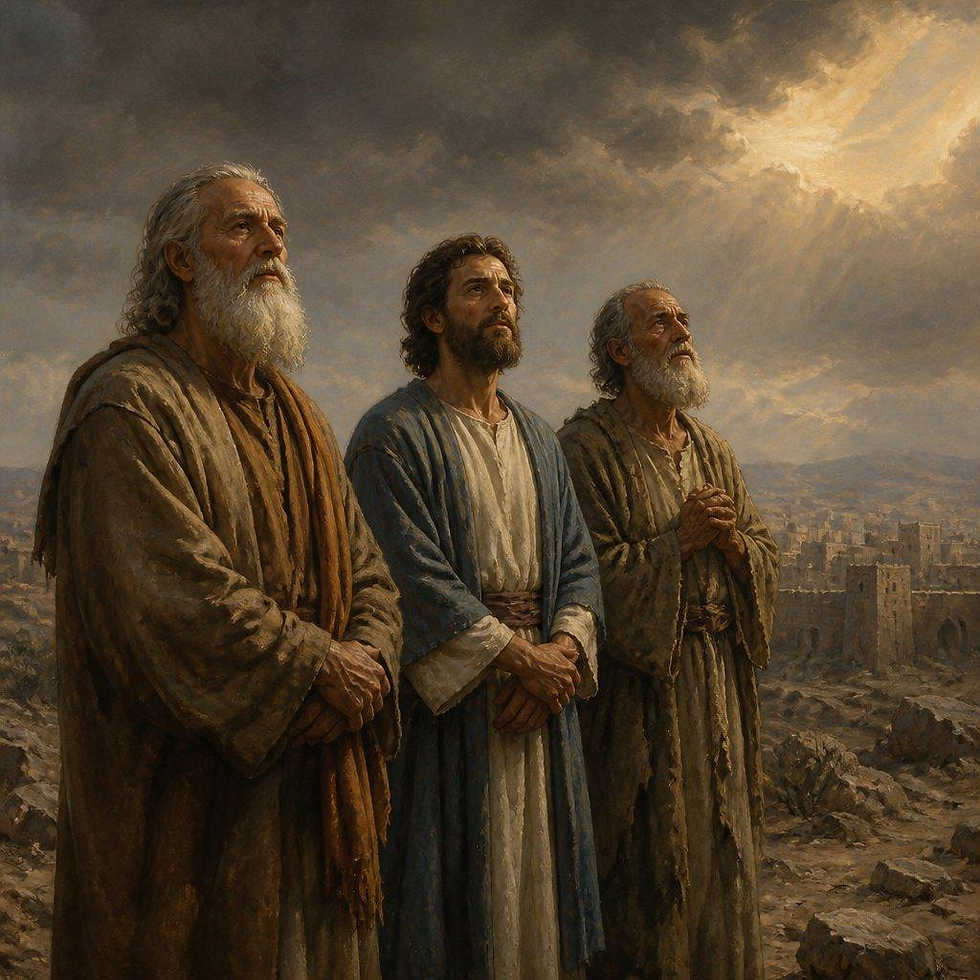
“Though these three men, Noah, Daniel, and Job, were in it, they should deliver but their own souls by their righteousness, saith the Lord God.” — Ezekiel 14:14, KJV
We have been following Noah through the darkest days in the history of the world.
We saw a man who found grace in the eyes of the Lord. We watched him build an ark while the world continued in its wickedness. And last week we saw the waters come, sweeping away a civilization that had filled the earth with violence.
Noah was righteous. Noah believed God. Noah obeyed God.
But centuries later, God would make a startling statement about Noah through the prophet Ezekiel.
He would place Noah beside two other remarkable men—Daniel and Job—and declare that even these three could not deliver a sinful nation.
Why would God choose these particular men? And what does their testimony teach us about the limits of human righteousness?
When God Spoke Through Ezekiel
Ezekiel was a prophet among the Jewish exiles in Babylon. Jerusalem was facing judgment because God's people had repeatedly turned away from Him. The nation had the privileges of God's covenant, His law, His temple, and His prophets. Yet those privileges had not produced the obedience God required.
Some people evidently hoped that the presence of righteous men might somehow protect the nation from judgment.
God answered that hope directly.
In Ezekiel 14, He names three men:
Noah. Daniel. Job.
The Lord says that even if these three were present in a land under judgment, they would deliver only themselves by their righteousness.
The repetition is important. God states the principle in verse 14 and returns to it in verse 20.
The righteousness of one man cannot simply be transferred to another. A nation's spiritual condition cannot be repaired merely because a few godly people live within it.
That is a sobering message for any generation that assumes it can remain secure indefinitely because it has inherited a Christian tradition, possesses a Bible, or remembers the achievements of faithful men and women who came before.
God is not indifferent to the presence of the righteous. But neither does He pretend that their righteousness makes the wicked innocent.
Let us consider the three men He chose.
1. Noah: A Righteous Man in a Corrupt World
We know Noah's story.
Genesis 6 tells us that the earth was corrupt before God and filled with violence. Humanity had turned so far from its Creator that judgment was coming upon the world.
Yet one man stood apart.
“Noah was a just man and perfect in his generations, and Noah walked with God” (Genesis 6:9).
The word perfect in the King James Version conveys the idea of being blameless or wholehearted. It does not mean that Noah was incapable of sin. The events following the Flood will make that plain.
Nevertheless, Noah believed God when the world around him had abandoned God's ways.
Hebrews 11:7 tells us that, by faith, Noah prepared an ark to save his household. His obedience became the means through which his family was preserved from the waters of judgment.
But consider what Noah could not do.
He could not make the violent people of his generation righteous. He could not persuade the whole world to repent. He could not prevent the judgment God had announced.
He could obey God himself. He could warn through his actions. He could build the ark as God commanded.
He could not supply righteousness to those who refused to believe.
And the Flood did not remove sin from the human heart. Noah and his family emerged into a cleansed world, but they remained members of the fallen human race.
The story of Noah is therefore not simply the story of a righteous man who survived a catastrophe. It is the story of God's judgment upon sin, His grace toward those who believe Him, and the continuing need for something greater than human righteousness.
2. Daniel: A Faithful Man in a Foreign Land
Daniel lived in a very different age.
He was carried away from Judah to Babylon as a young man. Far from Jerusalem, surrounded by a pagan culture, he faced pressures designed to reshape his loyalties and his worship.
Daniel resolved that he would not defile himself (Daniel 1:8).
He served under foreign rulers, interpreted dreams, survived political intrigues, and continued praying to the God of Israel even when prayer became a capital offense.
When his enemies sought grounds for accusation, they could find no corruption in his conduct. Their only hope was to make his faithfulness to God a crime.
Daniel was a man of extraordinary integrity.
Yet God placed his name in Ezekiel's prophecy not to suggest that Daniel could rescue Judah through his personal merit, but to establish the opposite.
Even Daniel's righteousness had limits.
His faithfulness could not cancel the rebellion of an entire nation. His prayers could not make persistent wickedness harmless. His courage could not turn God's judgment into an unjust act.
Daniel could remain faithful in Babylon. He could speak God's truth before kings. He could pray for his people and confess their sins before the Lord.
But he could not make the nation righteous simply by being righteous himself.
There is an important distinction here. Scripture certainly teaches us to pray for others, to seek their good, and to intercede for our nation. Daniel himself did these things in chapter 9 of his book.
Ezekiel's message is not that prayer is useless. It is that no amount of personal virtue gives us a claim upon God that overrides His holiness and justice.
Daniel could serve God faithfully in a fallen world. He could not become a substitute for the repentance of that world.
3. Job: A Righteous Man Who Suffered
Job brings a different dimension to the lesson.
The book bearing his name opens with God's own testimony concerning him. Job was “perfect and upright, and one that feared God, and eschewed evil” (Job 1:1).
Here was a man whose righteousness was not merely a public reputation. God Himself acknowledged his integrity.
Yet Job suffered devastating losses. His possessions disappeared. His children died. His health failed. His friends came to comfort him but repeatedly tried to explain his suffering by accusing him of hidden wrongdoing.
Job refused to accept their false accusations. But his suffering also brought him face to face with the limits of his own understanding.
At the end of the book, after God speaks to him out of the whirlwind, Job confesses:
“Wherefore I abhor myself, and repent in dust and ashes” (Job 42:6).
Job had been right to reject his friends' unjust charges. His suffering was not proof that he was secretly more wicked than other men.
But he was still a creature before his Creator. He could not comprehend all God's purposes, much less place God in the dock and demand that the Almighty answer to him.
And what could Job do for a sinful nation?
He could fear God. He could pray. He could offer sacrifices for his children, as we are told he did at the beginning of the book. He could endure suffering without abandoning his faith.
He could not make the guilty innocent by the strength of his own character.
Even the most upright man needs God's mercy.
Three Men, Three Ages, One Truth
Think about the extraordinary span of biblical history represented by these three names.
Noah belongs to the world before the Flood.
Job belongs to the patriarchal world of the ancient Near East.
Daniel belongs to the period of Judah's exile in Babylon.
They lived in different circumstances, faced different trials, and served God in different ways. Yet the Lord brings them together to establish one principle.
Righteousness is not transferable.
Noah could not make his generation righteous. Daniel could not make an unrepentant nation righteous. Job could not make the guilty righteous through his own integrity.
Their lives mattered enormously. Their faithfulness pleased God. Their examples continue to instruct us.
But none of them could accomplish what only God could accomplish.
This is why the Bible's account of humanity cannot end with admiration for a few good men.
We need more than examples to follow. We need forgiveness for our sins. We need hearts changed by God's grace. We need reconciliation with the God against whom humanity has rebelled.
The Old Testament repeatedly shows us the faithfulness of individual servants of God alongside the persistent unfaithfulness of the people among whom they live.
Even the best of these servants cannot become the final answer to humanity's problem.
The Righteousness We Need
The New Testament brings this truth into sharper focus.
Paul writes in Romans 3:23:
“For all have sinned, and come short of the glory of God.”
The problem is not confined to the people who lived before the Flood, the exiles in Babylon, or the wicked societies described by the prophets.
It reaches every generation.
And it reaches us.
We may admire Noah's faith, Daniel's courage, and Job's integrity. We should. Their lives demonstrate that faithfulness to God is possible even when circumstances are difficult and the surrounding culture is hostile.
But we cannot take refuge in their righteousness.
Nor can we take refuge in our parents' faith, our church's history, our nation's religious heritage, or the good works of other people.
Each of us stands accountable before God.
Yet the message of Scripture does not leave us without hope.
Paul goes on to explain that sinners may be justified freely by God's grace through the redemption that is in Christ Jesus (Romans 3:24).
Here is the difference between the finest human example and the gospel.
Noah could build an ark, but he could not remove sin from the world.
Daniel could remain faithful in Babylon, but he could not bear the guilt of Judah.
Job could endure suffering, but he could not provide the righteousness needed by every sinner.
Jesus Christ came to do what none of these men could do.
He lived without sin. He bore the judgment due to sinners. He died and rose again, and salvation is offered through faith in Him.
The righteousness we need is not something we inherit from another human being. It is God's gracious provision in Jesus Christ.
What About Our Own Generation?
Ezekiel's message deserves serious consideration today.
We may be grateful for Christian parents and grandparents. We may honor the men and women who established churches, preached the gospel, translated the Scriptures, and taught generations of children to pray.
We may rightly thank God for leaders whose integrity has strengthened their communities.
But we must never confuse the presence of righteous people with the repentance of a nation.
A church cannot believe in Christ on behalf of every person in its community. A godly parent cannot make faith a substitute for the child's own response to God. A nation's Christian past cannot guarantee its spiritual future.
We can teach. We can pray. We can preach. We can serve. We can bear witness to the truth of God's Word.
And we must do all these things faithfully.
But we cannot take the place of the Holy Spirit in bringing conviction of sin, nor can we take the place of Christ in saving sinners.
Our responsibility is to be faithful. The power to save belongs to God.
From Noah to Christ
We began with Noah, standing almost alone in a corrupt world.
We have seen Daniel maintaining his faith in a hostile empire and Job holding fast to God amid suffering he could scarcely understand.
Three men, separated by centuries, united by their reverence for the Lord.
Their righteousness was real. Their faith mattered. Their lives were not wasted.
But God Himself tells us that their righteousness had a boundary.
They could not save a nation.
And no man, however godly, can become the Savior of the world.
That is why we must look beyond Noah, Daniel, and Job to the One to whom the whole biblical story points.
Jesus Christ is not merely another example of faithfulness. He is the Savior whom sinners need.
The ark carried Noah's family through the waters of judgment. Daniel's faithfulness testified to the living God before earthly kings. Job's suffering reminds us that the righteous may endure trials whose purposes they cannot fully comprehend.
But Christ alone accomplished redemption.
As we continue our journey through Genesis, we shall see humanity begin again after the Flood. The earth will be repopulated. Nations will arise. Human ambition will reach toward heaven at Babel. And the story will eventually narrow to one man, Abraham, through whom God promises blessing to all the families of the earth.
The need for that blessing is already plain.
The Flood could wash the earth, but it could not wash sin out of the human heart.
A righteous man could stand against his generation, but he could not redeem it.
Humanity needed a Savior.
And God, in His own time, would provide Him.
Our hope is not that we can become righteous enough to save ourselves or others. Our hope is that God has provided the righteousness and redemption we cannot provide for ourselves.
“Thanks be unto God for his unspeakable gift.” -2 Corinthians 9:15
*******************************
Only Jesus! Only Jesus!
1 I’ve found a refuge from life’s care in Jesus,
I am hiding in His love divine;
He fully understands my soul’s deep longing,
And He whispers softly, “Thou art Mine.”
Chorus:
Only Jesus! Only Jesus!
Only He can satisfy;
Every burden becomes a blessing,
When I know my Lord is nigh.
2 I’ve found a precious joy in knowing Jesus,
Never dreamed of in this world of woe;
No clouds, however dark, can dim the radiance
Of the heav’nly light He doth bestow. (Chorus)
3 I’ve found a blessèd hope divine in Jesus,
’Tis a Day Star ever shining bright;
It fills my earthly way with heav’nly glory,
And it turns life’s darkness into light. (Chorus)
Avis B. Christiansen. 1895-1985
And when they had lifted up their eyes, they saw no man, save JESUS ONLY. Matthew 17:8
All men forsook me: I pray God that it may not be laid to their charge. Notwithstanding THE LORD stood with me, and strengthened me; 2 Tim 4:16-17
Who shall not fear thee, O Lord, and glorify thy name? for THOU ONLY ART HOLY: for all nations shall come and worship before thee; for thy judgments are made manifest. Rev 15:4


Comments