


Ephesians 4 and 5: From Our Calling to Our Conduct
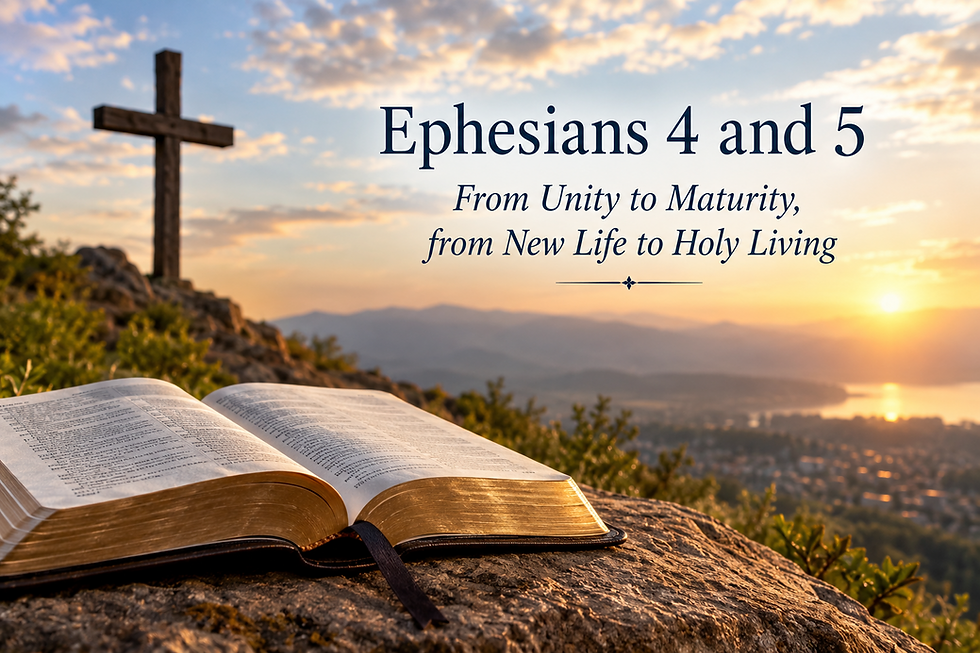
God at Work: From the Gospel’s People to God’s Great Purpose
The Life That Follows Grace
There is a turning point in Paul’s letter to the Ephesians. In the first three chapters, he has taken us into the great purposes of God: chosen in Christ, redeemed through His blood, made alive when we were dead in trespasses and sins, and brought near to God through the cross. Jew and Gentile alike have become members of one body, united in Christ and made heirs of the promises of God.
Now Paul turns from what God has done to what His people must become.
The transition is captured in the opening words of chapter 4: “I therefore, the prisoner of the Lord, beseech you that ye walk worthy of the vocation wherewith ye are called.”
That little word therefore carries the weight of everything that has gone before. Paul is not offering a ladder by which sinners may climb into God’s favor. He is describing the life that should follow when God, by His grace, has brought sinners into His family.
We do not earn our calling by the way we live. But our calling must make a difference in the way we live.
One Body, Many Gifts
Paul begins with humility, gentleness, patience, and the willingness to bear with one another in love. These are not spectacular virtues. They are the ordinary graces by which the unity of Christ’s church is preserved.
The unity itself rests upon something far greater than human agreement. Paul reminds his readers that there is one body, one Spirit, one hope, one Lord, one faith, one baptism, and one God and Father of all.
Yet unity does not mean that every Christian has the same work to do. Christ gives different gifts to different members of His body. Apostles, prophets, evangelists, pastors, and teachers are given for the equipping of the saints and the building up of the church.
Notice the purpose. Christian leaders are not meant to perform all the work while everyone else watches. They are to prepare God's people for service.
The result is a body that grows toward spiritual maturity, no longer tossed about by every new teaching or clever deception. Paul calls the church to speak the truth in love and to grow up into Christ, who is the Head.
Here is a necessary lesson for our own time. Truth without love can become harsh and destructive. Love without truth can become sentimentality, unwilling to confront error. Paul will not allow us to choose between them. The church must hold fast to the truth while speaking and acting in the spirit of Christ.
And every member matters. The body grows as each part performs its proper work.
The Old Life Must Be Put Away
Paul next reminds the Ephesians of the difference between their former lives and their new life in Christ. They must no longer walk as the Gentiles walk, in the futility of their minds, darkened in understanding and alienated from the life of God.
They have learned Christ differently.
The old self, corrupted by deceitful desires, must be put off. The mind must be renewed. The new self, created according to God in righteousness and true holiness, must be put on.
Paul makes this transformation wonderfully practical.
Let the thief steal no more, but work honestly, so that he may have something to give to those in need. Let corrupt communication be replaced by words that build others up. Put away bitterness, wrath, anger, clamor, slander, and malice. Be kind, tenderhearted, and forgiving, even as God for Christ’s sake has forgiven you.
Christianity reaches into our speech, our labor, our tempers, and our treatment of people who have wronged us.
It is possible to profess sound doctrine while speaking cruelly. It is possible to defend the truth while harboring bitterness. Paul leaves no room for the idea that Christian faith concerns only what we believe on Sunday.
The grace that reconciles us to God must also begin to change our relationships with one another.
Walking in Love
Chapter 5 opens with one of the most searching commands in the New Testament: “Be ye therefore followers of God, as dear children; And walk in love, as Christ also hath loved us, and hath given himself for us.”
Paul does not tell us merely to admire Christ’s love or to speak warmly about it. We are to walk in it.
The measure is the self-giving love of Christ, who gave Himself as an offering and sacrifice to God. Christian love is therefore more than friendliness, affection, or a desire to avoid unpleasant disagreements. It seeks the good of another, even when that good requires sacrifice from us.
But Paul immediately guards against a sentimental understanding of love. He names sexual immorality, impurity, covetousness, shameful speech, and foolish talk as things that have no proper place among God's holy people.
This is an important distinction. Love does not mean approving everything another person desires or does. Nor does Christian freedom mean that we may live as we please. Those who belong to Christ are called to a holiness that touches both conduct and conversation.
Paul also identifies covetousness as idolatry. That warning deserves particular attention. Idolatry is not confined to bowing before an image. Whatever we desire so greatly that it takes God's rightful place in our hearts has become a rival to Him.
A person may worship money, possessions, advancement, or personal pleasure without ever entering a pagan temple.
Paul's answer is not simply to condemn the old life. He calls believers to a new one, marked by thanksgiving. A grateful heart recognizes that life is received from God rather than seized for our own satisfaction.
From Darkness to Light
Then comes a striking description of the Christian change: “For ye were sometimes darkness, but now are ye light in the Lord: walk as children of light.”
Paul does not say merely that the Ephesians once lived in darkness. He says that they were darkness. Their condition was deeper than a collection of bad habits. They needed more than improved behavior; they needed the life of God.
Now they are light in the Lord.
The distinction matters.
Christians do not manufacture spiritual light by their own goodness. They have been brought into the light through Christ, and they are called to live consistently with what God has made them.
The fruit of that light is goodness, righteousness, and truth. Believers must learn to discern what pleases the Lord and refuse participation in the unfruitful works of darkness.
This calling is not a license for self-righteousness. We are not appointed to boast that we are better than others. We are called to lives so shaped by truth and goodness that darkness is exposed for what it is.
Paul even summons the sleeping to awake and rise from the dead, that Christ may give them light.
The Christian life is not meant to be lived half-awake, carried along by the habits and assumptions of the surrounding world.
We must be alert to the times, careful in our choices, and eager to understand the will of the Lord.
Filled with the Spirit
Paul brings these instructions together with another command: “Be filled with the Spirit.”
The contrast is between a life governed by intoxication and excess and a life governed by God's Spirit. The Spirit-filled life expresses itself in worship, thanksgiving, and mutual submission under the lordship of Christ.
Believers speak to one another in psalms, hymns, and spiritual songs. They sing and make melody in their hearts to the Lord. They give thanks always for all things to God the Father in the name of Jesus Christ.
This is not merely a description of a worship service. It is a picture of a people whose common life is being shaped by the presence of God.
The passage then moves into the household, addressing wives and husbands, children and parents, servants and masters. Paul is not changing subjects so much as bringing the gospel into the ordinary structures of life.
His words to husbands are especially searching. A husband is commanded to love his wife as Christ loved the church and gave Himself for her. Whatever else may be said about the responsibilities within a Christian household, this command cannot be separated from the sacrificial love of the Savior.
Christ's example overturns every attempt to use authority merely for selfish advantage. The husband is directed toward self-giving love, the kind that seeks the good and holiness of the one he loves.
Paul closes this section by returning to the great mystery of marriage: the two become one flesh. He then declares that this mystery ultimately points to Christ and the church.
Marriage, in Paul's teaching, is more than a social arrangement. It becomes a picture of the covenant love by which Christ has bound His people to Himself.
The Calling Becomes a Life
Ephesians 4 and 5 bring us from the great truths of salvation into the daily details of Christian living.
The church is to grow in unity and maturity. The individual believer is to put away the old life and put on the new. Love must be patterned after Christ's sacrifice. Light must replace darkness. Wisdom, thanksgiving, and the fullness of the Spirit must characterize the people of God.
None of this means that Christians achieve perfection by sheer determination. Paul has spent three chapters reminding us that salvation begins and rests in God's grace. But that grace is not barren. It produces a new direction, a new allegiance, and a new way of life.
We should therefore ask ourselves some honest questions.
Are we helping to build up the body of Christ, or are we weakening it through pride and bitterness?
Do our words give grace to those who hear them?
Are we learning to recognize the subtle forms of idolatry in our own hearts?
Does our conduct reflect the light into which Christ has brought us?
And does our love resemble the love of the One who gave Himself for us?
The answer to these questions is not found in our professions alone. It is found in the lives we live by the grace of God.
Paul began by urging us to walk worthy of our calling. He ends by showing us what that walk looks like—in the church, in our private conduct, in our homes, and in our relationships with others.
The great purpose of God is not merely to rescue people from judgment. He is forming a people who belong to Christ, who grow into His likeness, and who display His character before the world.
We have been called by grace. Now, by that same grace, let us walk worthy of the calling.
************************
STEPPING IN THE LIGHT
Trying to walk in the steps of the Savior,
Trying to follow our Savior and King;
Shaping our lives by His blessed example,
Happy, how happy, the songs that we bring.
Refrain:
How beautiful to walk in the steps of the Savior,
Stepping in the light, stepping in the light,
How beautiful to walk in the steps of the Savior,
Led in paths of light.
Pressing more closely to Him Who is leading,
When we are tempted to turn from the way;
Trusting the arm that is strong to defend us,
Happy, how happy, our praises each day.
Walking in footsteps of gentle forbearance,
Footsteps of faithfulness, mercy, and love,
Looking to Him for the grace freely promised,
Happy, how happy, our journey above.
Trying to walk in the steps of the Savior,
Upward, still upward, we follow our Guide;
When we shall see Him, “the King in His beauty,”
Happy, how happy, our place at His side.
Eliza E. Hewitt, c.1890
Then spake Jesus again unto them, saying, I am the Light of
the world: he that followeth me shall not walk in
darkness, but shall have the light of life John 8:12
+1


Comments