


Aging in the Bible: Growing Old in the Hands of God
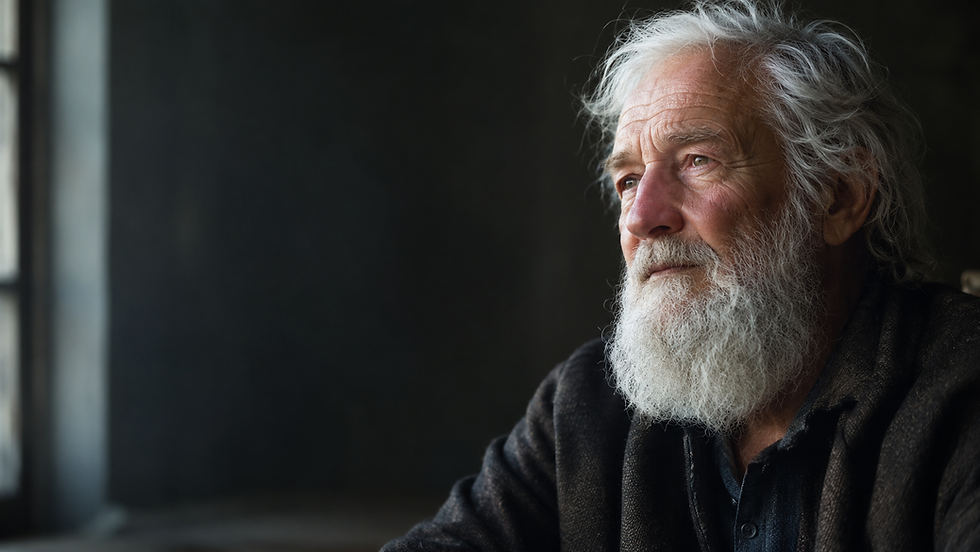
“They shall still bring forth fruit in old age; they shall be fat and flourishing.” — Psalm 92:14
I write this at age 80. This is a testimony of God's faithfulness: All I have needed Thy hand hath provided/Great is Thy faithfulness, Lord, unto me!
************************************
There is something remarkable about the way the Bible treats old age. It neither pretends that growing old is easy nor suggests that the years of our declining strength are years of declining usefulness to God.
The Bible tells us about old men whose eyes grew dim, whose bodies weakened, and whose earthly journeys approached their end. It also tells us about men and women whose greatest acts of faithfulness came late in life. Sometimes the two stories are the same story.
Isaac was old and his eyes were dim, so that he could not see (Genesis 27:1). Jacob, when he stood before Pharaoh, described his years as few and evil in comparison with the years of his fathers (Genesis 47:9). David, having reigned forty years, came to the end of his life at seventy (2 Samuel 5:4–5; 1 Kings 2:10–11).
The Bible does not hide the frailty of these men. Their importance to God did not exempt them from the ordinary burdens of human existence.
But neither did age bring their stories to an end before God was finished with them.
When Strength Gives Way to Faith
Perhaps one of the most revealing passages about aging is found in Ecclesiastes 12. The Preacher describes the approach of old age in a succession of vivid images: the keepers of the house tremble, the strong men bow themselves, those who look through the windows grow dim, and the grasshopper becomes a burden.
It is a poetic description of a body gradually losing its strength and its ease of movement. Those who have experienced old age may recognize themselves in it more readily than they would care to admit.
Yet the passage does not conclude in despair. It calls us to remember our Creator before the final days come, and it ends by directing us to the fear of God and obedience to His commandments (Ecclesiastes 12:13–14).
The point is not that youth is good and age is bad. The point is that life is a gift, time is passing, and our relationship with God must never be postponed.
The years of declining physical strength can become years of deepening dependence upon Him.
Caleb's Unfinished Business
One of my favorite biblical pictures of old age is Caleb.
At eighty-five, Caleb appeared before Joshua and reminded him of the promise Moses had made forty-five years earlier. He had been one of the two faithful spies who believed Israel could enter the Promised Land when the other ten spies discouraged the people.
Now, after decades of wandering and warfare, Caleb had not forgotten God's promise.
“Now therefore give me this mountain,” he said (Joshua 14:12).
He did not ask to be excused because of his age. Nor did he claim that the years had left him untouched. He simply believed that the Lord who had preserved him would continue to help him.
Caleb's story does not mean that every older person should undertake a mountain-climbing adventure. His particular calling was his own. But it does challenge the assumption that old age must be a season of surrendering every ambition or expecting nothing more from God.
Caleb had a mountain yet to possess.
What might faithfulness look like for us when we reach a stage of life in which some mountains are no longer ours to climb? Perhaps the mountain is a difficult reconciliation, a prayer that has continued for years, the encouragement of a younger believer, or the determination to finish our course without abandoning our confidence in Christ.
Our assignments may change. Our Lord does not.
Fruit in the Last Season
Psalm 92 gives us a promise that deserves particular attention:
“They shall still bring forth fruit in old age; they shall be fat and flourishing.”
The psalm is not promising that every older believer will enjoy good health or an easy life. Its picture is deeper than physical vigor. The righteous person, rooted in the Lord, continues to bear witness to His faithfulness.
There is a kind of fruit that becomes possible only after many years: the patience learned through disappointment, the sympathy born of sorrow, the humility that comes from discovering how little we control, and the quiet confidence of someone who has seen God keep His promises.
Such fruit rarely attracts attention. It may appear in a conversation, a letter, a prayer, or the example set for children and grandchildren. Sometimes the most valuable testimony an older Christian can offer is simply to continue trusting God when life has become difficult.
The world tends to measure usefulness by productivity, speed, and visible achievement. Scripture gives us another measure: faithfulness to the God who made us and redeemed us.
The Faithful Who Waited
Consider Anna, the elderly widow whom Luke introduces when Mary and Joseph bring the infant Jesus to the temple.
Anna had been married for seven years before becoming a widow, and Luke tells us that she was now of great age. She did not depart from the temple, but served God with fasting and prayers night and day.
When she saw the child Jesus, she gave thanks to God and spoke of Him to those who were waiting for the redemption of Jerusalem (Luke 2:36–38).
Think of what her story tells us. Anna had lived through years of loss. The life she might once have expected had not unfolded as she would have chosen. Yet she had not withdrawn into bitterness or abandoned hope.
She was still worshiping. Still praying. Still waiting for God to fulfill His promises.
And when the promised Redeemer appeared, she recognized the significance of the moment and told others.
Her years of waiting had not been wasted.
The Christian's Journey Toward Home
John Bunyan understood that the journey of faith could be long, demanding, and full of change. In the second part of The Pilgrim's Progress, Christiana travels toward the Celestial City with her children and companions. Her journey includes dangers, sorrows, fellowship, and the gradual preparation of a family of pilgrims for their final home.
Christiana's story is not simply a story about growing old. It is a story about continuing the pilgrimage when the road has exacted its cost and the goal has become more precious than ever.
Christian, in the first part of Bunyan's allegory, makes the journey alone. Christiana's journey reminds us that faithfulness can also include responsibilities for others: helping the young, encouraging fellow travelers, and learning to leave those we love in the care of the Lord.
Eventually, every earthly pilgrimage comes to its appointed end.
For the Christian, old age can bring that truth into sharper focus. We may find ourselves relinquishing responsibilities we once carried easily. Friends and family members may go before us. Familiar places and activities may become difficult or impossible to enjoy.
These losses should not be dismissed with easy words. They are real, and grief is not a failure of faith.
But neither are they the whole story.
The Christian's hope rests not in the preservation of earthly strength but in Jesus Christ, who has conquered death and promised eternal life to those who belong to Him.
Paul, writing near the end of his life, could say, “I have fought a good fight, I have finished my course, I have kept the faith” (2 Timothy 4:7).
His confidence was not that he had escaped every hardship. It was that, through all his hardships, he had remained the Lord's servant—and that the Lord would keep him to the end.
A Season Still in God's Hands
Aging in the Bible will not be a series about pretending that old age is easy. Nor will it be a lament for the years that have passed.
We will meet people who experienced weakness, loss, loneliness, and the burdens of responsibility. We will also discover older men and women whose faithfulness has much to teach us.
We will consider Moses, Caleb, Barzillai, Anna, and others whose stories illuminate different aspects of the later years. We will listen to the Psalms, which teach us to number our days and to seek God's help when our strength fails. And we will return to the question Bunyan's Christiana raises for every pilgrim: How shall we continue faithfully on the road to our heavenly home?
The answer is not that we must remain young in body or independent in every respect. It is that we must remain dependent upon the Lord.
The God who was faithful in our youth has not retired from our lives. The God who carried us through our middle years has not forgotten us now.
Moses prayed, “So teach us to number our days, that we may apply our hearts unto wisdom” (Psalm 90:12). The prayer is for all ages, but its urgency becomes clearer as the years accumulate.
We cannot recover yesterday. We cannot guarantee tomorrow. But today remains a gift from God.
And if we are still here, we may still worship, pray, encourage, serve, repent, forgive, and bear witness to His goodness.
The body may grow weaker. The road may grow harder. The destination, by God's grace, draws nearer.
Let us therefore grow old with our eyes upon the Lord—not because age is easy, but because He is faithful.
“They shall still bring forth fruit in old age.”
That is a promise worth remembering.
****************************
Thank You, Lord, for keeping me 80 years!
Thank You for never leaving or forsaking me.
Thank You for giving me Your work to do and
thank You for the fruit of old age! Keep me true!
********************************
All they who put their trust in God
Can never be removed;
They stand secure like Zion’s mount,
By many ages proved.
Refrain
Like the mount of God,
Like the mount of God;
They stand secure like Zion’s mount,
By many ages proved.
They can never be removed, removed;
They stand secure like Zion’s mount,
They can never be removed.
As round about Jerusalem
The rugged mountains lie,
So round about His holy saints
Our God is ever nigh.
Refrain
Tho’ fierce the storm in fury beat
And awful thunders roar,
The children of the mighty God
Are safe forevermore.
Refrain
Thus overshadowed by His love,
Where harm can ne’er betide,
Within this refuge safe and sure
I ever would abide.
Refrain
Clarence M. Seamans, 1902)
They that trust in the LORD shall be as mount Zion, which cannot be removed, but abideth for ever. Ps 125:1
Those who trust in the Lord are like Mount Zion, which cannot be shaken but endures forever. As the mountains surround Jerusalem, so the Lord surrounds His people both now and forevermore. (Psalm 125:1,2 NIV)

Comments