


Why Christmas Needs Poetry
Introduction:
Christmas is not just a feeling. It is a fact. It is the astonishing claim that God entered His own creation, that eternity stepped into time, that the invisible became visible, and that the Word took on flesh.
“And the Word was made flesh, and dwelt among us…” (John 1:14, KJV)
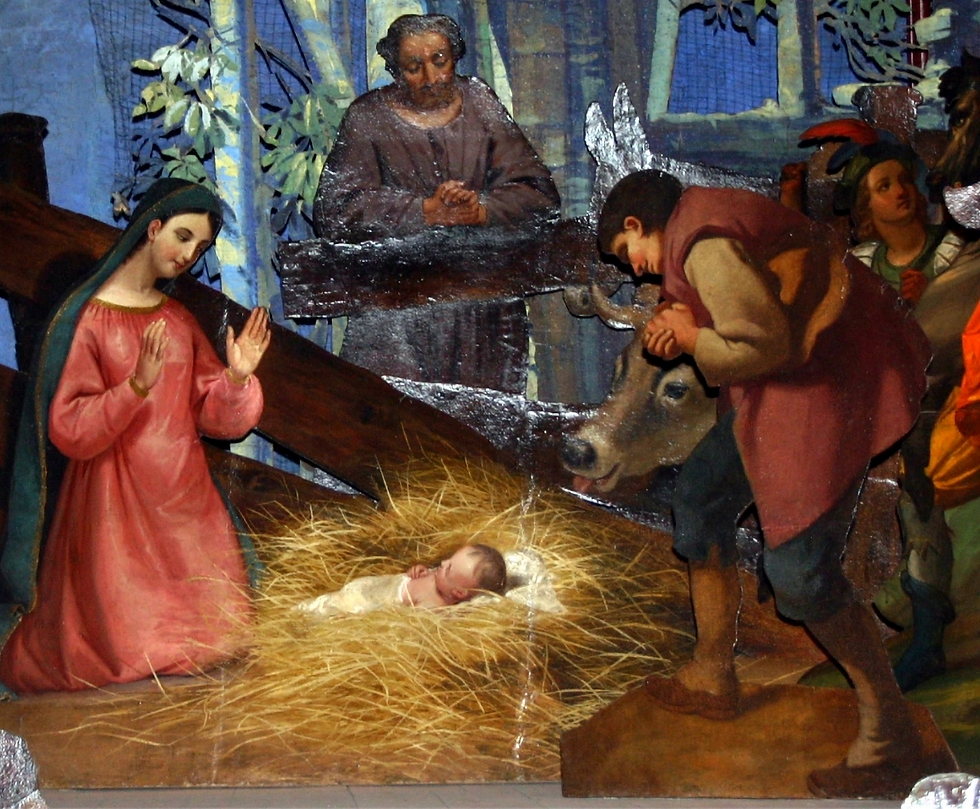
Paper on wood Nativity scene from 1750, Milan, presenting a tender image of Jesus
When I was in the primary class at Emmanuel Pentecostal Church in the 1950s, we little ones stood on the platform and repeated "Pieces" like this one:
I know of a name a beautiful name/ that unto a babe was given
The stars glittered bright t/hroughout that glad night
And angels praised God in heaven.
That was my introduction to poetry at Christmas, how was I to know the poetry had been going on for centuries? Read on, and see why!
*********************************
Such a mystery resists ordinary language. Prose explains, argues, and clarifies, but poetry adores, wonders, and lingers. That is why, from the earliest centuries of the Church, Christians have turned instinctively to poetry and hymnody at Christmas. When doctrine reaches its highest peak, poetry kneels.
Christmas poems slow us down in a season that rushes past too quickly. They invite us to ponder what cannot be hurried: the humility of the manger, the silence of Bethlehem, the condescension of the eternal Son of God. In poetry, we hear echoes of shepherds who “kept watch,” of Mary who “pondered these things in her heart,” and of wise men who traveled far before they truly saw.
This updated collection of Christmas poems is offered in that same spirit—not as sentiment, but as Incarnation faith. These poets, across centuries and traditions, bear witness to the same truth: that the Child in the manger is Emmanuel, God with us. Their words prepare the heart for Christmas Eve, and steady the soul for Christmas Day, reminding us that the joy of Christmas is not shallow cheer, but holy awe.
As we read and reflect, may these poems help us do what poetry does best—stand quietly before a mystery too great for words, and give thanks for God’s unspeakable gift.
Section I – The Hymns of the Incarnation
Before Christmas, poems were read silently on the page; they were sung aloud by the Church. Hymns have always carried doctrine on their backs, lodging truth not only in the mind but in the memory. At Christmas, they proclaim with clarity and confidence what the season means: the eternal Son of God has taken our flesh.
Few hymns express this better than Hark! the Herald Angels Sing by Charles Wesley. Often treated today as a cheerful carol, it is in fact a compact theological masterpiece. Wesley dares to place on the lips of angels the Church’s confession:
“Veiled in flesh the Godhead see; Hail the incarnate Deity.”
Here is Christmas in a single line: not God pretending to be human, not a divine spirit hovering near humanity, but God veiled in flesh—fully God and fully man.
Wesley’s hymn teaches congregations to sing Chalcedonian orthodoxy without ever using the word.
Another great hymn of the season, O Come, O Come, Emmanuel, reaches us through the careful translations of John Mason Neale, drawing on ancient Latin antiphons of the early Church. Its tone is more solemn, even yearning. Christmas here is not cozy; it is cosmic rescue:
“O come, Thou Dayspring, come and cheerOur spirits by Thine advent here.”
The hymn reminds us that Christ’s coming answers centuries of longing. Emmanuel—God with us—comes to ransom captive Israel, and by extension, a captive world.
Then there is O Little Town of Bethlehem, written by Phillips Brooks after visiting the Holy Land. Brooks captures a quiet paradox at the heart of Christmas:
“The hopes and fears of all the years Are met in thee tonight.”
Bethlehem is small, still, almost unnoticed—yet it becomes the meeting place of heaven and earth. God does not announce His coming with spectacle, but with presence.
Together, these hymns teach us how the Church has always sung Christmas: not as nostalgia, but as confession. They remind us that before we feel the season, we are called to believe it—to lift our voices and declare that the Word has indeed been made flesh and has dwelt among us.
Section II – English Poets and the Mystery of Christmas
If the great hymns proclaim the doctrine of Christmas aloud, the English poets linger over its mystery. They do not rush to explain how the Incarnation works; instead, they dwell on what it means—that God should stoop so low, and that heaven should come so quietly.
Among these voices, few are as beloved as Christina Rossetti. Her poem In the Bleak Midwinter strips Christmas of sentimentality and leaves us with a stark, reverent scene:
“In the bleak midwinter, frosty wind made moan, Earth stood hard as iron, water like a stone…”
Rossetti’s Bethlehem is cold and bare, a world inhospitable even to its Maker. Yet it is precisely here that love enters. The poem’s final question—“What can I give Him, poor as I am?”—turns the Incarnation inward. Christmas is not only about what God has given, but how we respond. Rossetti’s answer is as simple as it is demanding: “Give my heart.”
Earlier still is George Herbert, whose poetry is shaped by wonder at divine condescension. Though Herbert does not write a single famous “Christmas poem,” the Nativity breathes through The Temple. Again and again he returns to the same astonishment: that the God who fills heaven chooses humility, obscurity, and weakness.
For Herbert, devotion begins not with confidence but with reverent hesitation. His poems mirror the posture of the shepherds—approaching slowly, unsure, yet drawn onward by grace. Christmas, in Herbert’s vision, is God inviting the soul to come near without fear.
Then there is John Donne, whose Christmas meditations stretch the mind almost to breaking. Donne dares to hold together what seems impossible:
“Immensity cloistered in thy dear womb.”
In Donne’s hands, the Incarnation becomes a holy paradox: infinity contained, power made fragile, eternity wrapped in swaddling clothes. His poetry does not soften the mystery; it sharpens it, forcing us to confront the staggering truth that the baby of Bethlehem is the Lord of all creation.
Taken together, these poets teach us how to think slowly about Christmas. They remind us that the Incarnation is not a problem to be solved, but a wonder to be contemplated. In their lines, we hear the echo of Mary’s response to the angel: she does not explain—she ponders.
And so, through Rossetti’s tenderness, Herbert’s humility, and Donne’s daring, English poetry helps us stand where we ought to stand at Christmas: silent, attentive, and full of awe before the mystery of God made flesh.
Section III – Modern Voices: Christmas Seen Through Loss and Longing
Modern poets often approach Christmas from a different angle than the hymn writers and the earlier English poets. Writing in an age marked by war, disillusionment, and spiritual fragmentation, they tend to see the Nativity through darkness rather than candlelight. Yet it is precisely this setting that restores Christmas to its original seriousness.
A defining example is T. S. Eliot and his poem Journey of the Magi. Eliot strips away every trace of sentimental Christmas imagery. His Magi do not travel joyfully; they travel in hardship, cold, and doubt:
“A cold coming we had of it,Just the worst time of the yearFor a journey, and such a long journey…”
This is Christmas remembered from the far side of experience. The Magus who speaks has seen the Child—and nothing has been the same since. The poem ends not with triumph, but with unease:
“I should be glad of another death.”
Eliot reminds us that the Incarnation is not merely comforting; it is disruptive. To encounter Christ is to die to an old world and be born into a new one. Christmas, rightly understood, unsettles us before it saves us.
Alongside Eliot stands W. H. Auden, whose Christmas poetry and prose often emphasize the ethical demand of the Incarnation. Auden refuses to let Christmas remain abstract. If God has entered human history, then human history matters—its injustices, sufferings, and responsibilities.
For Auden, the Nativity exposes our evasions. God does not arrive in an ideal world, but in a broken one, and His coming forces a response. Christmas becomes a summons: if God has taken our flesh seriously, then we must take one another seriously as well.
These modern voices do not contradict the older hymns and poems; they confirm them from another direction. Eliot and Auden show us that the light of Christmas shines most clearly when the surrounding darkness is acknowledged. Their work brings us back to the realism of Bethlehem itself—a stable, a dangerous world, and a Child born under threat.
***
In this way, modern poetry rescues Christmas from nostalgia. It insists that the Incarnation still confronts us today, calling for repentance, reorientation, and hope grounded not in mood, but in truth.
Section IV – A New Addition for This Year: Journey of the Magi Revisited
To mark this year’s update, it is worth lingering a little longer with T. S. Eliot and Journey of the Magi, not merely as a modern Christmas poem, but as a deeply Christian meditation on conversion.
What makes Eliot’s poem especially fitting for Christmas is that it refuses to end at the manger. The speaker has seen the Child, has witnessed the moment when history turned—but the consequences of that moment stretch far beyond Bethlehem. The Magus returns home to a world that feels strangely alien:
“We returned to our places, these Kingdoms, But no longer at ease here, in the old dispensation…”
This is the cost of Christmas that is often left unspoken. To encounter Christ is to discover that the old order—old loyalties, old certainties, old comforts—can no longer fully satisfy. The birth of Jesus is not only a beginning; it is an ending as well.
Eliot’s final line, “I should be glad of another death,” shocks modern readers, but it would have been understood instinctively by earlier Christians. It is the language of dying to self, of passing from one life into another. Christmas, in this light, already carries within it the shadow of the Cross and the promise of Resurrection.
Including Eliot here serves a purpose beyond literary interest. It reminds us that the Incarnation demands response. The Child who lies in the manger grows to call disciples, to suffer, to die, and to rise again. Christmas is not complete unless it leads us onward—to repentance, to obedience, and to newness of life.
In a culture that prefers Christmas without cost, Eliot restores its seriousness. He teaches us that to welcome Christ truly is to accept transformation, even dislocation. And yet, for those who have seen Him, there is no going back—only forward, by grace.
Conclusion – Preparing for Christmas Eve and Christmas Day
As Christmas Eve approaches and the Church moves from expectation to celebration, poetry helps us make the transition with reverence rather than haste. These hymns and poems, written across centuries, draw us back to the same quiet center: the Word made flesh, dwelling among us.
They remind us that Christmas is not exhausted by a single night or a single day. It is an event that reshapes time itself. The shepherds return to their fields changed; the Magi go home by another way; Mary treasures and ponders what she has heard. In the same way, Christmas asks something of us—not merely that we feel joy, but that we receive Christ.
The Child in the manger is the Lord of glory. His coming calls us to wonder, to repentance, to gratitude, and to worship.
As we enter Christmas Eve and wake to Christmas Day, may these poems steady our hearts, slow our steps, and lift our eyes beyond the familiar scenes to the holy mystery they signify.
“Thanks be unto God for his unspeakable gift.” (2 Corinthians 9:15)
May that gift be received afresh this Christmas, with humility, faith, and joy.
******************
O holy night! The stars are brightly shining,
It is the night of our dear Saviour’s birth.
Long lay the world in sin and error pining,
‘Til He appear’d and the soul felt its worth.
A thrill of hope the weary world rejoices,
For yonder breaks a new and glorious morn.
Fall on your knees! O hear the angel voices!
O night divine, O night when Christ was born;
O night divine, O night, O night Divine.
Led by the light of Faith serenely beaming,
With glowing hearts by His cradle we stand.
So led by light of a star sweetly gleaming,
Here come the wise men from Orient land.
The King of Kings lay thus in lowly manger;
In all our trials born to be our friend.
He knows our need, to our weakness is no stranger,
Behold your King! Before Him lowly bend!
Behold your King, Before Him lowly bend!
Truly He taught us to love one another;
His law is love and His gospel is peace.
Chains shall He break for the slave is our brother;
And in His name all oppression shall cease.
Sweet hymns of joy in grateful chorus raise we,
Let all within us praise His holy name.
Christ is the Lord! O praise His Name forever,
His power and glory evermore proclaim.
His power and glory evermore proclaim.
---History and facts about O Holy Night.
O holy night is a wonderful Christmas Carol composed 1847 by the french composer Adolphe Adam.
The original lyrics to O Holy Night is a French poem named Minuit, Chrétiens – in English Midnight Christians – written by Placide Cappeau.
The English lyrics were written by the minister John Sullivan Dwight


Comments