


Theophany (80): The Departing Glory — When the Presence of God Leaves the Temple
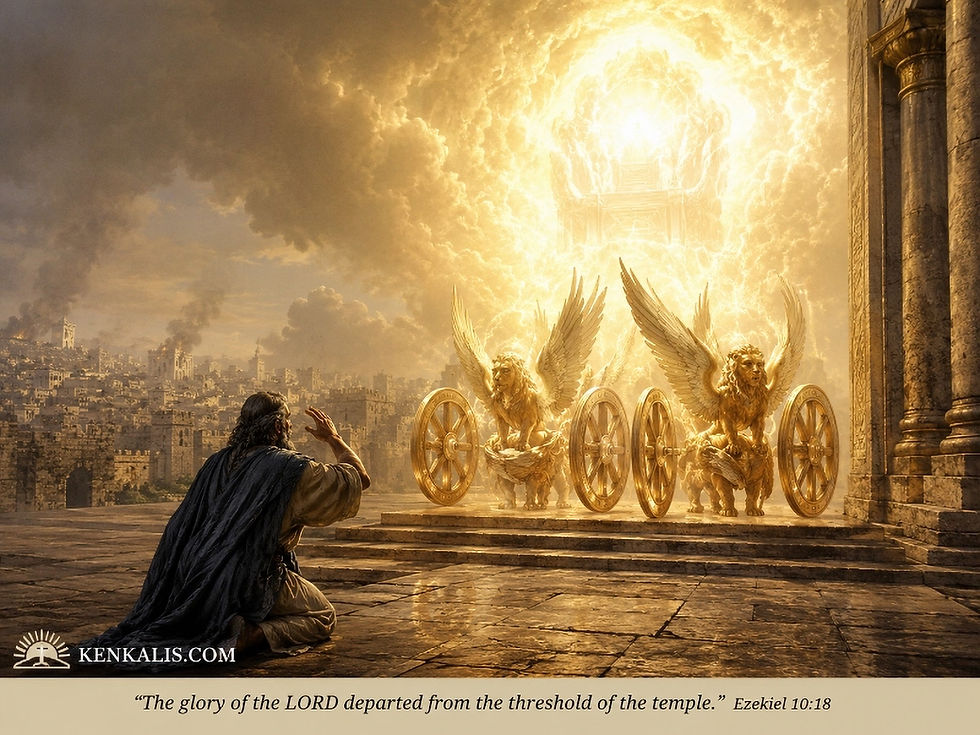
Scripture: Ezekiel 10
One of the most heartbreaking moments in all of Scripture is not the destruction of Jerusalem.
It is what happens just before it.
God leaves.
For centuries the Temple had stood as the visible reminder that the Lord had chosen to dwell among His covenant people. His glory had filled the Tabernacle in the wilderness. Later it filled Solomon's Temple with such overwhelming majesty that the priests could not continue their ministry.
"For the glory of the LORD filled the house of God." (2 Chronicles 5:14)
The Temple was never merely a magnificent building.
It was the place where heaven touched earth.
But now Ezekiel sees something almost unimaginable.
The glory begins to depart.
The Throne Above the Cherubim
Ezekiel again beholds the living creatures he first encountered by the River Chebar. Above them is the sapphire throne upon which the Lord reigns in sovereign holiness.
The wheels within wheels, flashing with fire and covered with eyes, remind us that God sees all things and rules over all creation. Nothing in history escapes His notice. Nothing happens outside His sovereign purpose.
Yet the focus of this chapter is not the cherubim.
It is the movement of God's glory.
The Glory Begins to Move
Earlier, the glory of the Lord had filled the Temple.
Now it rises.
The divine presence moves from above the cherubim to the threshold of the Temple.
The house fills with the cloud of God's glory one final time—not as a sign of blessing, but as a sign that His departure has begun.
The scene unfolds slowly, almost reluctantly.
God does not abandon His people hastily.
Generation after generation He had sent prophets.
He had warned.
He had pleaded.
He had disciplined.
He had called His people to repentance.
Only after persistent rebellion does His glory begin to withdraw.
"Then the glory of the LORD went out from the threshold of the house, and stood over the cherubim." (Ezekiel 10:18)
This is one of the saddest verses in the Old Testament.
The Presence that once filled the sanctuary now moves toward the exit.
Judgment Is God's Strange Work
God delights in mercy.
He takes no pleasure in judgment.
Throughout Scripture His patience is astonishing.
He warned Noah's generation.
He pleaded with Israel through Moses.
He sent prophet after prophet.
Judgment always comes as the final response to persistent unbelief.
The departing glory reminds us that outward religion can continue long after the heart has abandoned God.
The sacrifices were still being offered.
The priests still performed their duties.
The building still stood.
But the Presence was leaving.
Religion without God is an empty shell.
A Warning for Every Generation
The tragedy of Ezekiel's day is not confined to ancient Israel.
Church buildings may remain full.
Programs may flourish.
Traditions may continue.
Yet if hearts no longer love Christ, if truth is exchanged for compromise, if worship becomes performance rather than adoration, we should not assume that God's blessing automatically rests upon our activities.
The New Testament repeatedly calls believers to remain faithful.
Jesus warned several churches in Revelation that unless they repented, He would remove their lampstand.
God's people must never presume upon yesterday's blessings while neglecting today's obedience.
The Hope Beyond the Departure
Ezekiel's prophecy does not end with departing glory.
Later in the book he will witness something extraordinary.
The glory returns.
In Ezekiel's vision of the future Temple, the Lord once again fills His sanctuary.
Ultimately this points beyond any earthly building.
In Jesus Christ, God came to dwell among us.
"And the Word became flesh, and dwelt among us, and we beheld his glory..." (John 1:14)
After His resurrection, Christ sent the Holy Spirit to indwell every believer.
Today God's dwelling place is not a building made with hands but His redeemed people.
Yet the lesson of Ezekiel 10 remains.
God is holy.
His presence is not to be taken lightly.
His patience is immeasurable, but it must never be mistaken for indifference.
The departing glory is both a warning and an invitation.
It warns us against empty religion.
It invites us to seek the living God with humble, repentant hearts, rejoicing that through Jesus Christ the way into His presence has been opened forever.
Questions for Reflection
Am I relying on religious habit, or walking daily in fellowship with Christ?
Do I grieve over the sins that grieve God?
Is my worship centered on His presence, or merely on outward forms?
How does Christ fulfill what the Temple only foreshadowed?
Next week we will continue our journey through Ezekiel as God's glory completes its departure from Jerusalem before the coming judgment, reminding us that holiness and mercy always stand together in the purposes of God.
****************************************
*****************************************
1 God is working this purpose out,
as year succeeds to year;
God is working this purpose out,
and the time is drawing near;
nearer and nearer draws the time,
the time that shall surely be:
when the earth shall be filled with the glory of God
as the waters cover the sea.
2 From utmost east to utmost west,
where human feet have trod,
by the mouth of many messengers
goes forth the voice of God:
“Give ear to me, ye continents,
ye isles, give ear to me,
that the earth may be filled with the glory of God
as the waters cover the sea.”
3 Let us go forth in the strength of God,
with the banner of Christ unfurled,
that the light of the glorious gospel of truth
may shine throughout the world.
Let us all fight with sorrow and sin
to set the captives free,
that the earth may be filled with the glory of God
as the waters cover the sea.
4 All we can do is nothing worth
unless God blesses the deed.
Vainly we hope for the harvest-tide
till God gives life to the seed.
Yet nearer and nearer draws the time,
the time that shall surely be,
when the earth shall be filled with the glory of God
as the waters cover the sea.
Author: Arthur Campbell Ainger (1894)


Comments