


Theophany (72) — Lifted Between Earth and Heaven: Idolatry in the Temple

The visions granted to Ezekiel now move deeper into the heart of Israel’s spiritual crisis.
What began beside the river Chebar now carries the prophet into Jerusalem itself.
The Lord will no longer merely announce judgment — He will reveal why judgment must come.
Ezekiel is about to see what ordinary eyes could not see.
He will be lifted “between the earth and the heaven” and shown the hidden sins concealed beneath outward religion.
The Temple still stood. Sacrifices still continued. Priests still ministered. The forms of worship remained.
But inside, corruption had spread into the very courts of God.
The Hand of the Lord Falls Again
Ezekiel writes:
“And it came to pass in the sixth year, in the sixth month, in the fifth day of the month, as I sat in mine house, and the elders of Judah sat before me, that the hand of the Lord GOD fell there upon me.”— Ezekiel 8:1
Again, the prophet experiences the overwhelming invasion of divine presence.
The elders sit before him — perhaps curious, perhaps skeptical, perhaps hoping for reassuring words about Jerusalem’s future. But instead of comfort, Ezekiel receives another terrifying revelation.
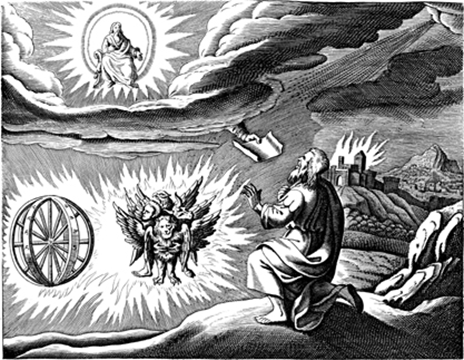
He sees once more the radiant figure he encountered earlier:
“Then I beheld, and lo a likeness as the appearance of fire… and from his loins even upward, as the appearance of brightness, as the colour of amber.”— Ezekiel 8:2
The glory of God has not diminished.
But now that glory becomes the light exposing hidden darkness.
Between Earth and Heaven
Then comes one of the most astonishing moments in the entire book:
“The spirit lifted me up between the earth and the heaven, and brought me in the visions of God to Jerusalem.”— Ezekiel 8:3
Ezekiel is carried by the Spirit into a supernatural vantage point.
Neither fully on earth nor fully removed from it.
Suspended between realms.
The prophet becomes a witness to what heaven sees.
This is one of the frightening truths of Scripture: God sees beyond appearances. He sees beyond ceremonies, reputations, religious language, and public performances.
Man sees the outer court.
God sees the hidden chamber.
The Image of Jealousy
Ezekiel arrives at the Temple gate and immediately sees something horrifying:
“The image of jealousy, which provoketh to jealousy.”— Ezekiel 8:3
An idol stood near the very place dedicated to the worship of Jehovah.
The Lord calls it an image of jealousy because idolatry is not merely theological error — it is covenant betrayal.
Israel belonged to God, yet they welcomed rival loves into His house.
And the tragedy deepens:
“The glory of the God of Israel was there.”— Ezekiel 8:4
The glory remained present even while abominations filled the Temple courts.
What a sobering picture.
It is possible to preserve religious structure while grieving the heart of God.
Idolatry in Hidden Chambers
The Lord then leads Ezekiel deeper.
He sees a hole in the wall. He is commanded to dig through it. Behind it lies a secret chamber filled with creeping things, idols, and pagan imagery covering the walls.
Inside stand seventy elders of Israel offering incense in secret worship.
These are not pagan invaders.
These are Israel’s leaders.
Men entrusted with spiritual responsibility.
And they whisper to themselves:
“The LORD seeth us not.”— Ezekiel 8:12
This is always where spiritual collapse begins.
Not merely in outward sin, but in the inward belief that God does not truly see.
Hidden sin survives by imagining hiddenness from God.
But heaven’s eyes penetrate walls.
Greater Abominations
Three times the Lord tells Ezekiel:
“Thou shalt see greater abominations.”— Ezekiel 8
The corruption intensifies step by step.
Women mourn for Tammuz — a pagan fertility deity.
Then Ezekiel sees men standing in the Temple court with their backs toward the sanctuary of God while worshiping the rising sun in the east.
The symbolism is devastating.
They have literally turned their backs on the Lord.
The Temple still exists outwardly, but inwardly, another god has taken the throne.
Religion without devotion becomes desecration.
The Danger of Outward Religion
Ezekiel 8 remains painfully relevant.
The chapter warns us that it is possible to maintain the appearance of faith while the heart quietly drifts into idolatry.
Modern idols rarely appear as carved statues. Although the Roman Catholic church has done so throughout its churches.
In us, they appear as pride.
Control.
Comfort.
Political obsession.
Pleasure.
Reputation.
Self-worship.
Anything enthroned where God alone belongs becomes an image of jealousy.
And often these idols flourish most easily in hidden chambers no one else sees.
But the Lord still searches walls.
He still sees secret places.
He still calls His people to wholehearted devotion.
The God Who Sees
The terrifying element of Ezekiel’s vision is also its mercy.
God reveals the corruption before judgment fully falls.
Exposure itself is an act of grace.
The Lord does not expose sin because He delights in condemnation. He exposes it because He desires repentance.
Darkness brought into light can still be healed.
But concealed rebellion hardens the heart.
Scripture repeatedly reminds us:
“All things are naked and opened unto the eyes of him with whom we have to do.”— Hebrews 4:13
Nothing remains hidden forever.
Where We Go Next
The vision is not over.
What Ezekiel has seen explains why judgment approaches — but now the consequences will unfold.
In the next Theophany, heavenly executioners will appear in Jerusalem, and a mysterious man clothed in linen will mark those who still grieve over the sins of the city.
Judgment is coming.
But even in wrath, God will still distinguish those whose hearts remain faithful to Him.
*************************
Holy Father in heaven, You are the God who sees. Help me see as You see and deliver me from idolatry as I ask in Jesus' name. Amen.
To pray this prayer with me, write in the Comments section below, and believe He will answer, for His is faithful. Ken
*********************
Search me, O God,
And know my heart today;
Try me, O Savior,
Know my thoughts, I pray.
See if there be
Some wicked way in me;
Cleanse me from every sin
And set me free.
---J. Edwin Orr, 1936.


Comments