


The Pilgrim’s Progress, Part X: The River, the Celestial City, and the End of the Journey
At last Christian and Hopeful came within sight of the Celestial City.
The air grew sweeter.The shining ones appeared more often.And from the distance the pilgrims could hear voices from the gates above.
Yet one final barrier remained between them and the City:
“There was a deep River, but there was no Bridge to go over.”
Christian trembled when he saw it.
Then the pilgrims asked the men who stood nearby:
“How shall we get over?”
And they answered:
“You must go through, or you cannot come at the Gate.”
The River is Bunyan’s image of death itself.
No one enters the Celestial City without crossing it.
Entering the River
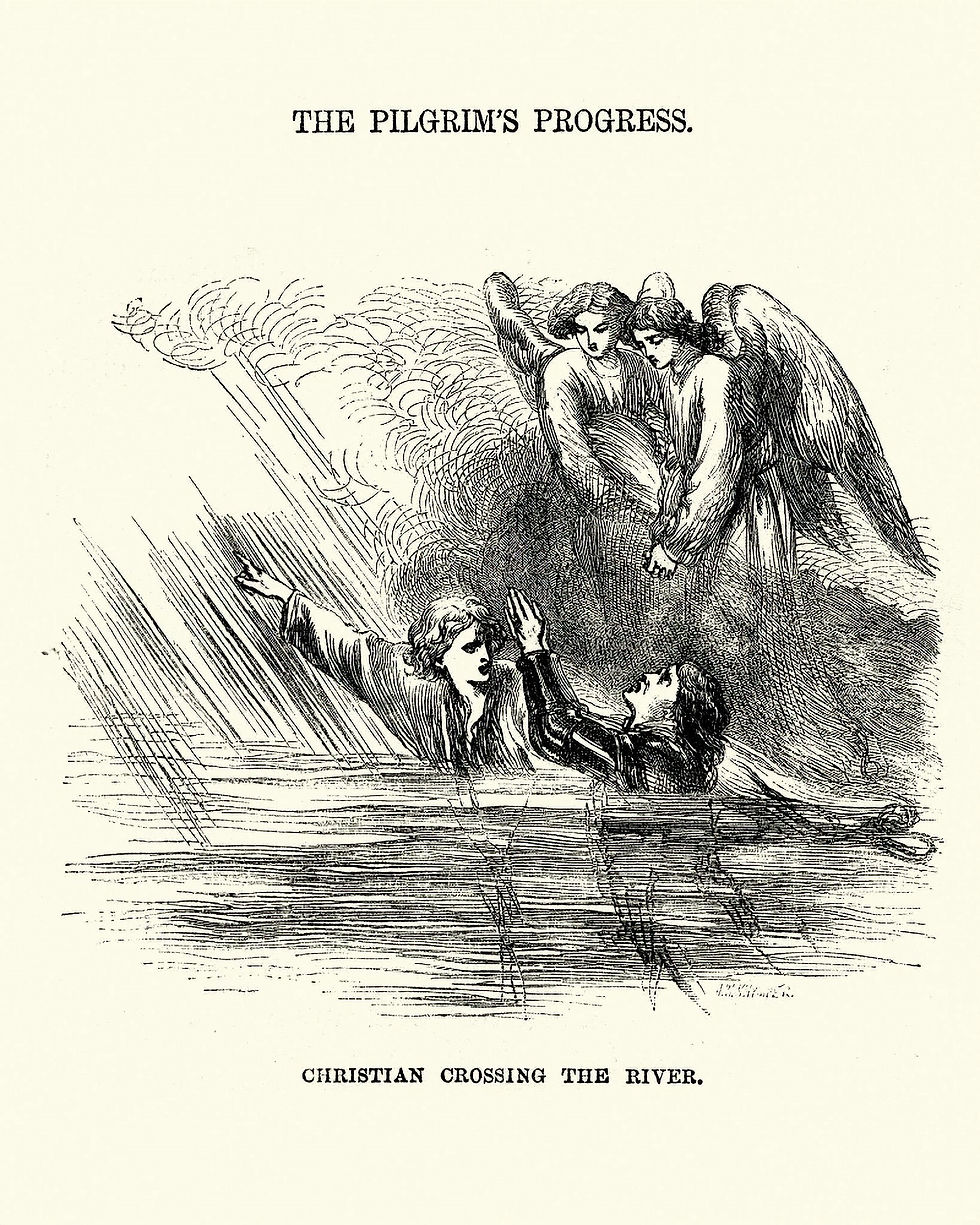
Then they addressed themselves to the water.
At first the crossing was difficult, and Christian soon began to sink under fear.
He cried out:
“I sink in deep Waters; the Billows go over my head, all his Waves go over me. Selah.”
Hopeful answered him tenderly:
“Be of good cheer, my Brother, I feel the bottom, and it is good.”
But Christian’s distress only deepened.
“Ah my Friend,” said he, “the sorrows of Death have compassed me about; I shall not see the Land that flows with Milk and Honey.”
And then Bunyan gives us one of the most human moments in the entire book.
Christian says:
“I am in my sins, and they are gone over my head; I am going to the bottom; all the waves go over me.”
Even at the very edge of the Celestial City, the pilgrim struggles with fear and assurance.
But Hopeful would not leave him to despair.
“These troubles and distresses that you go through in these Waters are no sign that God hath forsaken you; but are sent to try you, whether you will call to mind that which heretofore you have received of his goodness.”
Then Hopeful reminded Christian of the promises of Christ.
Gradually Christian began to recover strength.
Soon he cried:
“Ah! I see him again; and he tells me, When thou passest through the Waters, I will be with thee; and through the Rivers, they shall not overflow thee.”
The words of Scripture become his comfort at the hour of death.
And so together they passed through the River.
The Celestial City
Once safely across, the shining ones greeted them.
Bunyan writes:
“The Bells of the City rang again for joy, and it was said unto them, Enter ye into the joy of your Lord.”
The pilgrims were clothed in garments that shone like gold.
They ascended toward the gate while heavenly music filled the air.
Christian and Hopeful asked many questions as they went upward.
“What must we do in the holy place?”
And the shining ones answered:
“You must there receive the comforts of all your toil, and have joy for all your sorrow.”
They were told:
“There you shall see Seraphims and Cherubims continually.”
And:
“There you shall walk and talk with the King, even all the days of eternity.”
At the gate the men looked upon the pilgrims’ certificates and carried them to the King.
Then came the final command:
“Let these enter in.”
And Bunyan says:
“I looked in after them, and behold the City shone like the Sun; the streets also were paved with Gold, and in them walked many men, with Crowns on their heads, Palms in their hands, and golden Harps to sing praises withal.”
At last the pilgrimage was complete.
The Fate of Ignorance
But Bunyan does not end with triumph alone.
Another man comes to the River: Ignorance.
Unlike Christian and Hopeful, he had trusted in himself rather than in the King.
He crossed the River easily enough and approached the gate confidently.
But when the King’s servants asked for his certificate, he had none.
Then Bunyan writes these terrible words:
“They took him up, and carried him through the Air to the door that I saw in the side of the Hill, and put him in there.”
And Bunyan concludes:
“Then I saw that there was a way to Hell, even from the Gates of Heaven.”
The warning is unmistakable.
Nearness to religion is not the same as salvation.Confidence is not the same as faith.Only those clothed in the righteousness of Christ enter the City.
Where We Go Next
Though Christian’s pilgrimage has ended, Bunyan’s story is not over.
He later wrote a second part to The Pilgrim’s Progress following the journey of Christian’s wife Christiana, their children, and their companions along the same road.
And many readers through the centuries have found Part II just as rich, tender, and spiritually profound as the first volume — sometimes even more so.
Where Part I often emphasizes struggle, danger, conviction, and perseverance, Part II gives greater attention to fellowship, hospitality, family discipleship, marriage, pastoral care, and growing together in grace.
The road to the Celestial City is not walked by solitary pilgrims alone.
-----------------------------------
A Final Word Before We Continue
As we conclude Part I of The Pilgrim’s Progress, we encourage our readers to consider reading John Bunyan’s work in full.
Over the past months, we have journeyed with Christian through the Slough of Despond, the House Beautiful, Vanity Fair, Doubting Castle, the Delectable Mountains, and at last the River and the Celestial City itself. Yet what we have presented here is only a portion of Bunyan’s complete masterpiece.
The full Pilgrim’s Progress — including both Part I and Part II — contains more than 100,000 words and has nourished Christians for more than three centuries. Our series has offered selected passages, reflections, and guided excerpts designed to help modern readers enter Bunyan’s world without losing the richness of his language and spiritual insight.
And the deeper one goes into Bunyan’s work, the more rewarding it becomes.
What makes The Pilgrim’s Progress endure is not merely its allegory, but its humanity. Christian fears, stumbles, doubts, rejoices, argues, listens, repents, and perseveres. His conversations with Faithful, Hopeful, and others often illuminate the Christian life with remarkable honesty and wisdom.
Many readers are surprised to discover how readable, emotionally vivid, and spiritually searching Bunyan’s writing still is today.
We especially encourage you not merely to read about the pilgrims, but to listen carefully to the pilgrims themselves.
Their voices have strengthened generations of believers.
And the story is not over.
In Part II, Bunyan turns from Christian’s solitary pilgrimage to the journey of Christiana, the children, and their companions. Many readers through the centuries have found this second part just as rich, tender, and spiritually profound as the first — sometimes even more so.
Where Part I often emphasizes struggle, danger, conviction, and perseverance, Part II gives greater attention to fellowship, hospitality, family discipleship, marriage, pastoral care, and growing together in grace.
The road to the Celestial City is not walked by solitary pilgrims alone.
Next time we begin:
The Pilgrim’s Progress, Part II — Christiana’s Jour
*****************************************
Holy Father in heaven, I thank You today for Your gifts of John Bunyan and Pilgrim's Progress. Your will be done in earth as it is in heaven through Your Son who died for our sins and opened the gate of salvation and eternal life to us. I come to You in His name rejoicing and giving thanks. Amen
Pray with and for me by writing in the Commets section below. God bless you today. -- Ken
*****************************************
How Firm a Foundation
How firm a foundation, ye saints of the Lord,
Is laid for your faith in His excellent Word!
What more can He say than to you He hath said,
You, who unto Jesus for refuge have fled?
When through the deep waters I call thee to go,
The rivers of woe shall not thee overflow;
FOR I WILL BE WITH THEE, THY TROUBLES TO BLESS,
AND SANCTIFY TO THEE THY DEEPEST DISTRESS
-----1787; at¬tributed to John Keene, Kirk¬ham, and John Keith.


Comments