


Sunday Morning Bible Study — 1 Corinthians 5–6: Purity, Integrity, and the Temple of the Holy Spirit
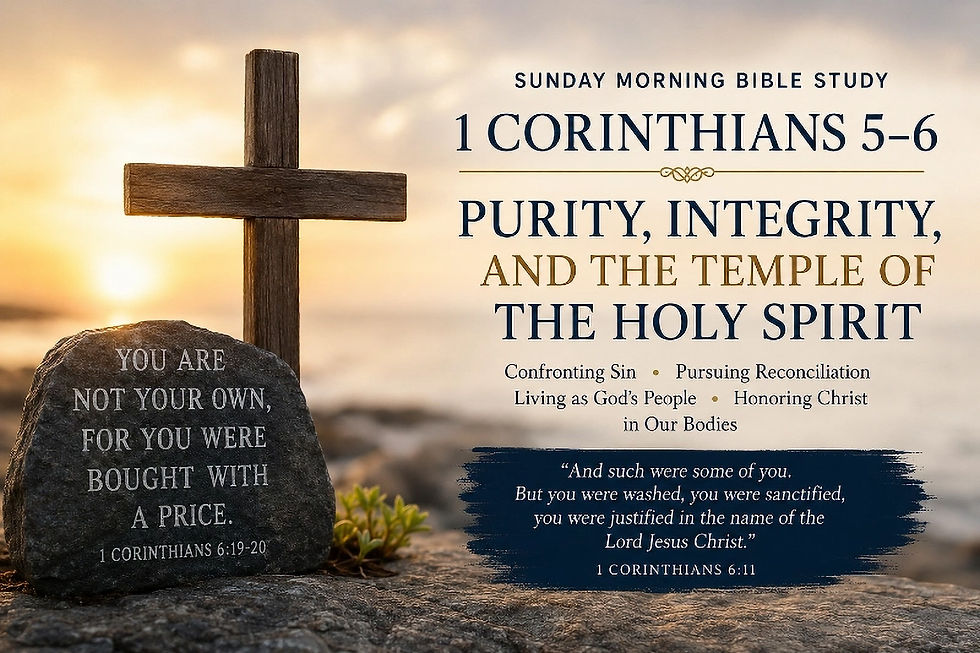
Last week in chapters 3–4, Paul confronted the Corinthians for their spiritual immaturity, pride, and obsession with human leaders. Now the letter turns sharper and more personal. In chapters 5–6, Paul addresses sins the church had tolerated, lawsuits between believers, and a distorted understanding of Christian freedom.
The issue is no longer simply division in the church. The issue is holiness.
Paul reminds the Corinthians—and us—that salvation is not merely about what we believe with our lips, but about how Christ transforms our lives.
A church that boasts in wisdom while tolerating open rebellion against God has forgotten what it means to belong to Jesus.
1 Corinthians 5 — When the Church Stops Mourning Sin
Paul opens chapter 5 with shocking news: a man in the church is living in open sexual immorality, and the congregation is tolerating it. Worse, they seem proud of their tolerance rather than grieved by the sin.
“And you are arrogant! Ought you not rather to mourn?”— 1 Corinthians 5:2
The problem is not only the man’s sin. The problem is the church’s response.
Paul teaches an uncomfortable but essential truth: love does not ignore destructive sin. A healthy church cannot celebrate what God calls evil while claiming to honor Christ. Paul compares tolerated sin to leaven spreading through dough:
“A little leaven leavens the whole lump.”— 1 Corinthians 5:6
The image is clear. Sin never remains isolated. What is excused eventually spreads.
Yet even here, Paul’s goal is not cruelty or humiliation. Church discipline is meant to awaken repentance and ultimately restore the sinner. The purpose is redemption, not revenge.
This chapter is deeply countercultural. Modern culture often defines love as unconditional affirmation. Paul defines love differently. Real love warns. Real love grieves. Real love seeks restoration before destruction becomes complete.
The church is not called to judge the world’s unbelief. Paul explicitly says God will judge outsiders. But the church is called to take seriously the holiness of those who bear Christ’s name.
That truth remains difficult—and necessary.
1 Corinthians 6:1–11 — Brothers Dragging Brothers to Court
Paul then addresses another scandal: believers suing one another before pagan courts.
The issue is not whether governments or legal systems have legitimate authority. Scripture elsewhere affirms lawful government.
Paul’s concern is that Christians who claim to belong to the kingdom of God are publicly devouring one another instead of pursuing reconciliation.
“Why not rather suffer wrong? Why not rather be defrauded?”— 1 Corinthians 6:7
That sentence cuts against every instinct of pride and self-protection.
The Corinthians were eager to win arguments but unwilling to lose for the sake of Christ. Paul sees this as a spiritual defeat even before the court case begins.
Then comes one of the most sobering passages in the letter:
“Do not be deceived: neither the sexually immoral, nor idolaters, nor adulterers… will inherit the kingdom of God.”— 1 Corinthians 6:9–10
But Paul does not end there.
“And such were some of you. But you were washed, you were sanctified, you were justified in the name of the Lord Jesus Christ.”— 1 Corinthians 6:11
This is the glory of the gospel.
The church is not a gathering of morally superior people. It is a gathering of redeemed sinners.
The Corinthians had once lived in darkness, but Christ had cleansed them. Therefore they could no longer live as though nothing had changed.
Grace is not permission to remain unchanged. Grace transforms.
1 Corinthians 6:12–20 — Your Body Belongs to Christ
The final section confronts one of Corinth’s deepest errors: the belief that spiritual life and bodily behavior were disconnected.
Some in Corinth apparently argued that bodily desires were morally insignificant. Paul rejects this entirely.
“The body is not meant for sexual immorality, but for the Lord.”— 1 Corinthians 6:13
Christianity is not a religion that despises the body.
God created the body. Christ took on a human body. Christ rose bodily from the grave. And believers themselves will be raised bodily.
Paul’s logic is stunning:
“Do you not know that your bodies are members of Christ?”— 1 Corinthians 6:15
And then:
“You are not your own, for you were bought with a price.”— 1 Corinthians 6:19–20
Modern culture endlessly repeats the phrase: my body, my choice.
Paul says something radically different:
Your body belongs to the Lord who redeemed you.
This is not slavery—it is liberation. Sin promises freedom while destroying the soul. Christ claims us in order to restore us.
Paul calls believers to flee sexual immorality, not flirt with it. He understands how deeply sexual sin reaches into the human person. Sexuality is not merely physical appetite; it involves covenant, union, and worship.
The Christian life therefore cannot be reduced to outward religion while inward desires run unchecked. Christ claims the whole person—mind, soul, body, desires, habits, relationships, and worship.
What These Chapters Teach Us
1 Corinthians 5–6 reminds us that the church is called to be different from the world—not through self-righteousness, but through holiness shaped by grace.
These chapters confront several modern illusions:
that tolerance is always love
that private sin affects no one else
that personal freedom is the highest good
that bodies and souls can be separated
that grace means God no longer cares how we live
Paul says otherwise.
The gospel does not merely forgive sinners. It creates a new people who belong to Christ.
And because we belong to Him, purity matters. Integrity matters. Reconciliation matters. What we do with our bodies matters.
Not because we earn salvation by holiness—but because those who have been washed are no longer who they once were.
Where We Go Next
In chapters 7–8, Paul turns to questions about marriage, singleness, Christian liberty, and life in a pagan culture. The Corinthians wanted simple rules. Paul instead teaches them how to live wisely and faithfully in every area of life.
The call to holiness will continue—but now it will move into the ordinary relationships and decisions of everyday life.
Thank You, Lord Jesus, for dying for us that we might be redeemed, transformed and filled with the Holy Ghost. Help us today, Lord, acknowledge our need and look to You for all that we need. Amen
To join me in this prayer write your need in the Comments section below and I will pray with and for you in the poser of the Holy Ghost. Ken
-----------------------------
Nor silver nor gold hath obtained my redemption;
No riches of earth could have saved my poor soul.
The blood of the cross is my only foundation;
The death of my Savior now maketh me whole.
I am redeemed, but not with silver;
I am bought, but not with gold;
Bought with a price—the blood of Jesus,
Precious price of love untold.
2
Nor silver nor gold hath obtained my redemption;
The guilt on my conscience too heavy had grown.
The blood of the cross is my only foundation;
The death of my Savior I only can own.
3
Nor silver nor gold hath obtained my redemption;
The holy commandment forbade me draw near.
The blood of the cross is my only foundation;
The death of my Savior removeth my fear.
4
Nor silver nor gold hath obtained my redemption;
The way to God’s kingdom could not thus be bought.
The blood of the cross is my only foundation;
The death of my Savior redemption hath wrought.
James Martin Gray (1851-1935)


Comments