


Poetry Tuesday: T. S. Eliot (3): Ash Wednesday — Learning to Turn Toward God
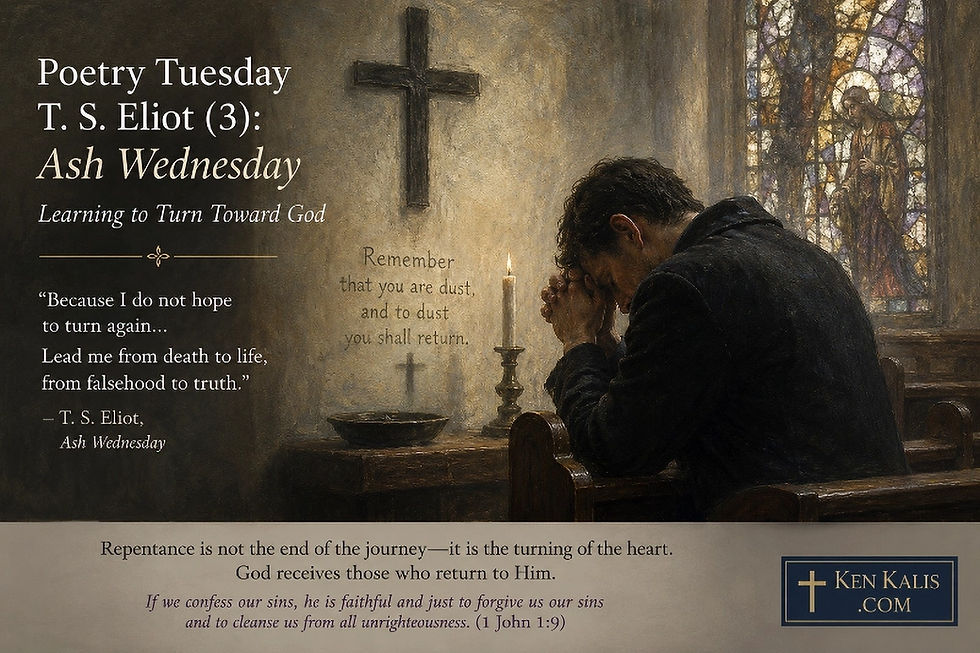
"Because I do not hope to turn again..."
When readers first encounter Ash Wednesday, they are often surprised. It is not a triumphant hymn of certainty. It is the prayer of a soul learning to repent.
That is precisely why it remains one of T. S. Eliot's greatest Christian poems.
Having come to faith in Christ, Eliot discovered what every believer eventually learns: conversion is not the end of the journey. It is the beginning.
The Christian life is a continual turning toward God.
The title itself points us to the first day of Lent—a season of repentance, humility, and preparation for the cross. Ash Wednesday reminds us of our mortality:
"Remember that you are dust, and to dust you shall return."
Yet it also reminds us that God's mercy is greater than our failures.
The poem opens with words that seem almost discouraging:
"Because I do not hope to turn again..."
At first glance they sound hopeless.
But Eliot is actually renouncing his old ambitions, old pride, and old self-reliance. He is no longer hoping to find fulfillment in the things that once captivated him. Instead, he is learning to depend entirely upon God's grace.
Throughout the poem we encounter themes that echo the Scriptures:
repentance instead of self-confidence,
surrender instead of control,
grace instead of achievement,
silence instead of endless argument,
hope instead of despair.
Like David after his sin, like Peter after denying Christ, and like Paul after meeting Jesus on the Damascus Road, Eliot understands that the Christian life begins with admitting our need.
The journey is difficult.
There are moments of doubt.
There are moments of dryness.
There are moments when faith feels more like perseverance than celebration.
Yet beneath every stanza lies an unmistakable confidence that God is still drawing the believer toward Himself.
Perhaps the most comforting truth in Ash Wednesday is that spiritual maturity does not require perfection.
It requires repentance.
God welcomes those who keep turning toward Him, even when they come slowly, weakly, or with trembling hearts.
The ashes of repentance become the soil from which resurrection hope grows.
As Scripture reminds us:
"If we confess our sins, he is faithful and just to forgive us our sins and to cleanse us from all unrighteousness." (1 John 1:9)
Eliot's poem reminds us that the Christian life is not measured by how rarely we fall, but by how faithfully we continue to return to Christ.
In that sense, every day can become an Ash Wednesday—and every Ash Wednesday points us toward Easter morning.
Coming Next Week: The Four Quartets (1): Burnt Norton — Time, Eternity, and the Presence of God.
Carry These Words With You
"Because I do not hope to turn again..."
"Teach us to care and not to care..."
"Suffer me not to be separated..."
Read these lines again before the day is over. Let them settle quietly into your heart. Great Christian poetry is not meant merely to be admired—it is meant to draw us closer to the God who inspired the longing from which it was written.
Coming Next Tuesday: Burnt Norton — Time, Eternity, and the God
********************************
Thank You, Lord Jesus, for T.S. Eliot and his testimony for You. Bless every reader today, and draw us all closer to Your feet and to the life and truth that only You can give. Amen
********************************
O Thou, the contrite sinner’s friend,
Who loving, lov’st them to the end,
On this alone my hopes depend,
That Thou wilt plead for me.
When weary in the Christian race,
Far off appears my resting place,
And, fainting, I mistrust Thy grace,
Then, Savior, plead for me.
When I have erred and gone astray,
Afar from Thine and wisdom’s way,
And see no glimmering, guiding ray,
Still, Savior, plead for me.
When Satan, by my sins made bold,
Strives from Thy cross to loose my hold,
Then with Thy pitying arms enfold,
And plead, O plead for me.
And when my dying hour draws near,
Darkened with anguish, guilt, and fear,
Then to my fainting sight appear,
Pleading in Heav’n for me.
When the full light of heavenly day
Reveals my sins in dread array,
Say Thou hast washed them all away;
O say, Thou plead’st for me!
Words: Charlotte Elliott, 1835.


Comments