


Poetry Tuesday: Paradise Regained — Book IV: The Victory of the Second Adam

For four weeks we have accompanied John Milton through Paradise Regained, watching the conflict between Satan and the Son of God unfold in the wilderness. Unlike Paradise Lost, which spans heaven, earth, and hell, this poem is intimate and restrained. Milton focuses our attention on one battlefield: the steadfast obedience of Jesus Christ.
Book IV brings the contest to its conclusion. Satan has exhausted many of his temptations, yet he refuses to yield. If he cannot entice Christ through hunger, worldly ambition, or political power, perhaps he can succeed through pride.
His final assaults become increasingly desperate, but every one of them is answered by the quiet authority of God's Word.
Milton's purpose is not simply to retell the Gospel narrative. He wants us to see that where the first Adam fell through disobedience, the Second Adam triumphs through perfect obedience.
Paradise is regained not by force of arms, but by unwavering faithfulness to the Father's will.
The Last Offer of Earthly Glory
Satan once more displays before Christ the kingdoms of the world in all their magnificence. Thrones, armies, wealth, fame, and dominion are spread before Him. It is the same temptation offered earlier in another form: possess the crown without the cross.
Christ sees through the deception. Earthly kingdoms rise and fall. Their glory is temporary. His kingdom comes not by compromise with evil but by obedience to His Father.
Milton allows Christ's answer to carry the force of the argument:
"Hence, Satan! get thee hence!"
The victory is not won through eloquence or spectacle. Christ simply refuses what the Father has not given Him.
How different this is from our own hearts. We often long for influence, recognition, or success apart from God's timing. Jesus teaches us that no earthly prize is worth abandoning perfect obedience to the Father.
"For what shall it profit a man, if he shall gain the whole world, and lose his own soul?" — Mark 8:36
The Temptation of Human Wisdom
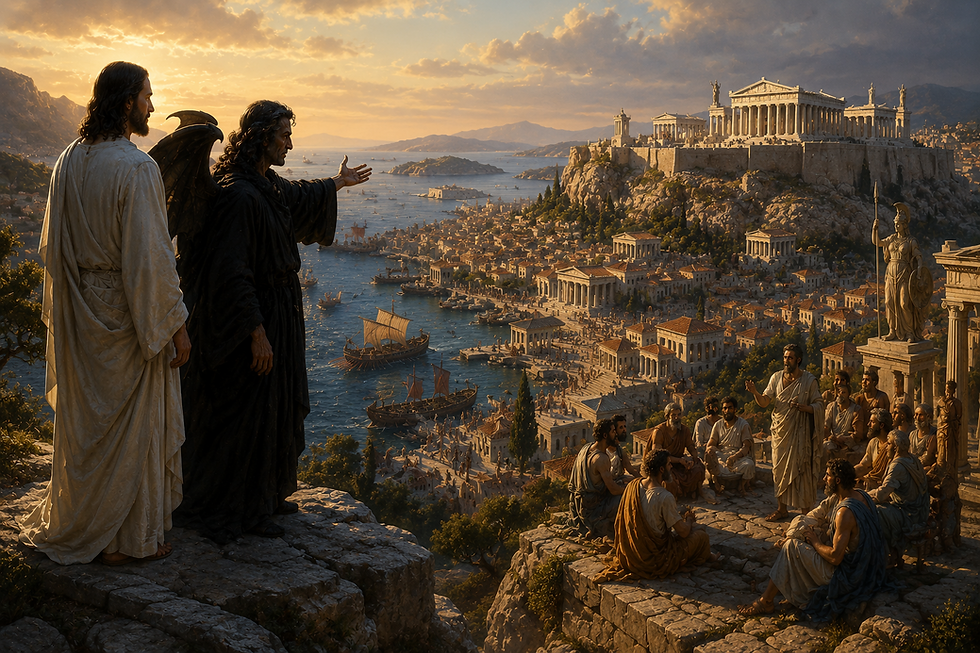
Having failed with political power, Satan changes tactics. He leads Christ through the great centers of ancient learning—Athens, Rome, and the celebrated schools of philosophy.
Milton clearly admired classical learning, yet he knew its limits. Human wisdom, however brilliant, cannot reconcile sinners to God.
Satan praises the philosophers, poets, and statesmen of antiquity as though they possess the answers to life's deepest questions.
Christ is unmoved.
True wisdom begins with the fear of the Lord. Every system of thought that ignores God ultimately proves insufficient.
Milton gently reminds us that intellectual achievement is no substitute for divine revelation. Education is a gift, but it becomes dangerous when it teaches people to trust their own understanding rather than God's Word.
"The fear of the Lord is the beginning of wisdom." — Psalm 111:10
The Pinnacle of the Temple
At last Satan resorts to his final temptation.
He carries Christ to the pinnacle of the Temple in Jerusalem.
There he twists Scripture itself, urging Jesus to cast Himself down, claiming that God's angels will surely bear Him safely.
This temptation is subtle because it appeals to religious presumption rather than open rebellion. Satan urges Christ to force God's hand—to demand miraculous proof of the Father's care.
Jesus answers with another passage of Scripture.
"Thou shalt not tempt the Lord thy God."
Faith trusts God's promises.
Presumption demands that God prove Himself.
Milton beautifully captures the difference. Christ refuses to manipulate the Father. He will wait upon God's will rather than seeking dramatic displays.
This lesson remains profoundly relevant today. We are often tempted to seek spectacular signs when God calls us instead to quiet faithfulness.
Satan Defeated
With this final answer the conflict ends.
Satan has nothing left.
The one who overcame Adam in Eden has been overcome in the wilderness.
Milton portrays his defeat not with elaborate drama but with quiet certainty.
The enemy departs because he has met One who cannot be turned from obedience.
The victory belongs entirely to Christ.
This is the heart of Paradise Regained. Jesus conquers precisely where humanity failed. Every temptation that overcame Adam has met its answer in the steadfast obedience of the Son of God.
Angels Minister to the Victor
After Satan departs, angels come to minister to Christ.
The scene is peaceful rather than triumphant.
There is no earthly celebration.
No crowds gather.
No kingdoms are established.
Jesus simply returns from the wilderness prepared for the public ministry that will ultimately lead Him to the cross.
Milton ends quietly because God's greatest victories often appear ordinary to the world. The decisive battle has already been won through perfect obedience.
The cross still lies ahead, but the character of the Redeemer has been fully revealed.
Paradise Regained
Milton opened this poem with the promise of "Recover'd Paradise."
Now that promise has been fulfilled.
The first Adam lost paradise through disobedience.
The Second Adam begins restoring it through obedience.
Milton summarizes his purpose in words that beautifully frame the entire poem:
"Recover'd Paradise to all mankind,/By one man's firm obedience fully tried."
The victory of Christ in the wilderness points forward to Calvary, where His obedience would be completed through His sacrificial death and glorious resurrection.
Our hope rests not in our own ability to resist temptation, but in the perfect obedience of Jesus Christ, who stood where Adam fell and remained faithful where every other person has failed.
As we close our journey through Paradise Regained, Milton leaves us with a Savior who conquers not by worldly power but by humble submission to His Father's will.
That same victorious Savior still calls His people to trust Him, obey His Word, and follow Him in faithful perseverance until the day when Paradise is fully restored.
"For as by one man's disobedience many were made sinners, so by the obedience of one shall many be made righteous." — Romans 5:19
******************************************
Thank You, Lord Jesus, for redeeming Adam's race, especially me. Thank You, too, for teaching me how to use God's Word to command the devil "Get thee hence.:
******************************************
Base tempter, hence depart,
The dreadful charge withdraw;
Too true indeed, I’ve often sinned,
But Christ has kept the law.
Shouldst thou with crimes accuse,
The guilty charge I own;
But trust the promise and the grace
Of God’s incarnate Son.
That boundless grace and love,
Which thou shalt never share,
Is the foundation of my hope,
A refuge from despair.
Enhanced as is my guilt,
Couldst thou increase the score,
I’d fly the swifter to the cross,
And watch and pray the more.
Words: Benjamin Beddome (1717–1795).


Comments