


Peter and John: The Men Who Carried Pentecost Forward
Key Scriptures: Acts 3–4
Study 3 — God at Work After Pentecost
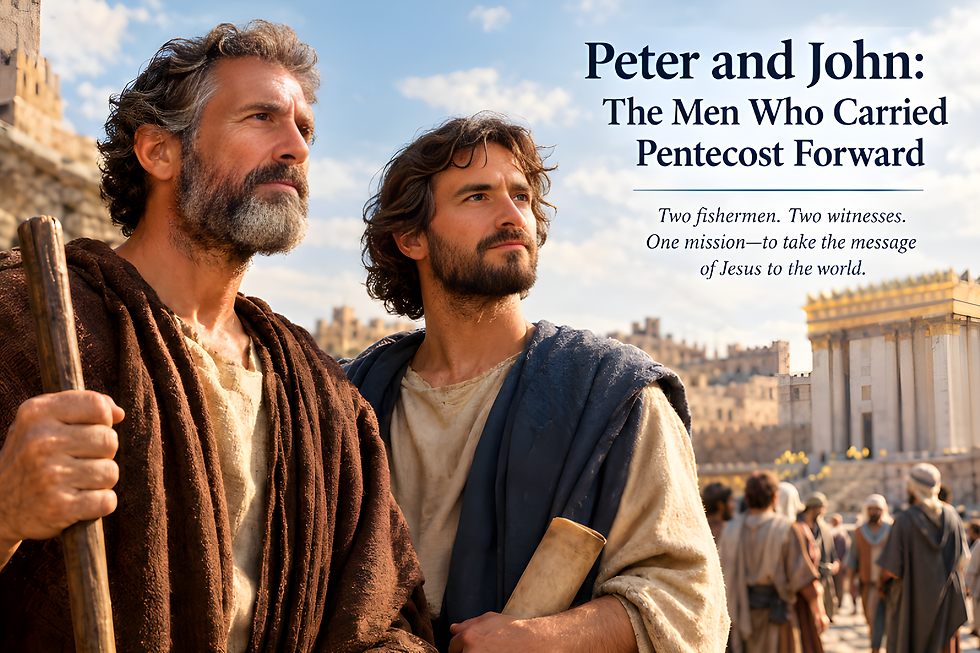
Pentecost was not the end of the story.
It was the beginning.
The Holy Spirit came upon the waiting disciples. Peter stood and preached. Three thousand people believed. A new community was born in Jerusalem.
But what happened next?
The answer is found not only in what God did, but in what God did through people.
Two of those people were Peter and John.
They were very different men. Peter was outspoken, impulsive, and often quick to act. John was quieter, reflective, and eventually became known for his deep emphasis on love.
Two men who had walked with Jesus, struggled to understand His mission, and were transformed by the risen Christ and the Holy Spirit. And both were now being used by God to carry the message of Pentecost into the world.
Their story helps us see something we can easily miss when we read Acts.
God was building His church, but He was building it through flesh-and-blood people.
From fishermen to witnesses
Peter and John had once been fishermen on the Sea of Galilee.
Jesus called them, along with their brothers and companions, to leave their nets and follow Him.
They had watched Jesus heal the sick, confront demons, forgive sins, teach the crowds, and raise the dead. They had seen Him enter Jerusalem to shouts of praise and then be arrested, condemned, crucified, and buried.
And they had seen Him alive again.
Then came Pentecost.
Peter, who had once denied Jesus three times, now stood before a crowd in Jerusalem and boldly proclaimed that the crucified Jesus was both Lord and Christ.
John stood with him.
The frightened disciples of the night of Jesus' arrest were becoming courageous witnesses.
That transformation is one of the first great signs of Pentecost.
The Holy Spirit did not erase their personalities. He changed what those personalities were capable of doing.
Peter was still Peter.
John was still John.
But now their lives were being directed by a power greater than themselves.
The man at the temple gate
Soon Peter and John were going to the temple to pray.
At the gate called Beautiful, they encountered a man who had been unable to walk from birth.
He asked them for money.
Peter answered him:
“Silver and gold have I none; but such as I have give I thee.”
Then Peter told him to rise and walk in the name of Jesus Christ.
The man did.
The crowd was astonished.
Peter immediately used the moment to point away from himself.
The miracle was not Peter's accomplishment.
It was evidence that the Jesus whom the people had rejected was alive and at work.
Peter preached again.
And once again, the authorities were disturbed.
This is an important pattern for the years ahead.
The church would grow because ordinary people testified to an extraordinary Christ.
“We cannot but speak”
Peter and John were arrested and brought before the religious authorities.
They were asked by what power or what name they had acted.
Peter answered with remarkable courage.
The man had been healed through the name of Jesus Christ of Nazareth.
The authorities recognized something else.
They recognized that Peter and John were ordinary men.
Yet these ordinary men spoke with extraordinary boldness.
Why?
Because, as Acts tells us, they had been with Jesus.
The authorities ordered them not to speak or teach in Jesus' name.
Peter and John had a choice.
Be quiet.
Or continue the work.
Their answer became one of the defining statements of the early church:
“We cannot but speak the things which we have seen and heard.”
That sentence deserves to stay with us as we follow the church through the next three centuries.
The Christian movement did not spread because its first believers possessed political power.
They did not have armies.
They did not control governments.
They did not have impressive buildings.
They had a story they believed was true.
They had seen Jesus.
They had received the Holy Spirit.
And they could not keep silent.
Peter and John were not alone
There is another reason Peter and John matter to our story.
They remind us that the church was never a one-man operation.
Peter preached, but others served.
John witnessed, but others carried the message farther.
Believers shared their possessions.
They cared for widows.
They welcomed strangers.
They taught their children.
They prayed.
They suffered.
They traveled.
Names begin appearing throughout the New Testament.
Stephen.
Philip.
Barnabas.
James.
Paul.
Timothy.
Priscilla and Aquila.
These were not characters in a religious legend.
They were real people living in real cities, making real decisions, facing real dangers, and telling real neighbors about Jesus.
The church grew as these people took responsibility for the gospel they had received.
And that is the important bridge from Pentecost into history.
When the apostles would no longer be here
Peter and John belonged to the first generation.
They had personally known Jesus.
But that generation would not live forever.
Peter would eventually die.
Paul would die.
James would die.
John himself would grow old.
The apostles would disappear from the scene one by one.
But the church would remain.
That raises a question that will guide us for the rest of this series:
What happens when the people who knew Jesus personally are gone?
The answer is one of the most remarkable stories in Christian history.
The faith did not die with the apostles.
It moved outward.
It crossed geographical boundaries.
It entered cities and cultures far beyond Jerusalem.
It was carried by people whose names we know and by thousands whose names we never will.
Some would preach.
Some would write.
Some would teach.
Some would suffer.
Some would die.
And some would simply live faithful Christian lives in places where no historian ever recorded their names.
But together they carried Pentecost forward.
From Jerusalem to the Roman world
Peter and John therefore stand at a crossroads in our story.
Behind them is Pentecost.
Ahead of them is a world waiting to hear.
The book of Acts will tell us some of what happened next. Paul will take the gospel into the Gentile world. Churches will appear in Antioch, Corinth, Ephesus, Philippi, Rome, and many other places.
But eventually we must leave the pages of Acts.
That is where our journey becomes even larger.
We will meet the generation that came after the apostles.
We will meet men such as Ignatius of Antioch and Polycarp of Smyrna.
We will encounter believers who defended the faith before hostile Roman authorities.
We will see Christianity spread across the empire.
We will watch the church endure periods of terrible persecution.
And eventually we will come to a moment nobody standing in Jerusalem on the day of Pentecost could have imagined.
A Roman emperor will openly favor the Christian faith.
The persecuted church will find itself connected to imperial power.
The little movement that began in Jerusalem will become a major force in the Roman world.
That emperor will be Constantine.
But we are not there yet.
For now, we are standing with Peter and John.
Two fishermen.
Two witnesses.
Two men who had failed Jesus and been restored by Him.
Two men who had no idea how far the message they were proclaiming would travel.
God works through people
There is a temptation when we tell the story of the early church to say simply:
God did it.
And, of course, He did.
The church is God's church.
The Holy Spirit is God's Spirit.
The gospel is God's message.
But God chose to work through people.
He worked through Peter.
Through John.
Through Paul.
Through Barnabas.
Through Stephen.
Through Priscilla and Aquila.
Through countless men and women whose names are recorded in Scripture—and countless others whose names are known only to God.
That is important for us to remember.
God's work in history does not usually look like heaven reaching down and doing everything while human beings stand on the sidelines.
More often, it looks like God taking ordinary people, filling them with His Spirit, giving them courage, and sending them into the world.
Peter and John carried Pentecost forward.
And then others carried it farther still.
The story we are following is about to leave Jerusalem.
It is about to leave the pages of Acts.
And it is about to become the story of a church that will spread across an empire—and eventually stand before an emperor.
Pentecost was only the beginng.
When we talk about God being at work after Pentecost, it is tempting to picture God doing everything while His people simply watch.
Acts gives us a very different picture.
God is certainly at work. The Holy Spirit has come. Jesus is risen. The gospel is going forward.
But look at the people God is using.
Peter. John. A man who had never been able to walk. Religious leaders. Ordinary believers gathering together to pray.
They are not shadows in the background.
They are flesh-and-blood people making decisions, taking risks, speaking words, showing courage, and sometimes facing opposition.
And God is working through them.
That is what makes Acts so exciting.
Peter and John Go to the Temple
Acts 3 begins very simply:
Peter and John are going up to the temple at the time of prayer.
They are doing what they have apparently done many times before.
There is nothing spectacular about walking to the temple to pray.
But they encounter someone whose life is about to change.
A man who had been unable to walk since birth is being carried to the temple gate. Every day he is placed there to beg from people going into the temple.
When he sees Peter and John, he asks them for money.
Peter looks directly at him.
John is there beside him.
And Peter says:
“Look at us!”
The man gives them his attention, expecting to receive something.
Peter then says something that must have surprised him:
“Silver or gold I do not have, but what I do have I give you.”
Peter has no money to offer.
But he has something greater.
He has Jesus.
“In the Name of Jesus Christ”
Peter tells the man:
“In the name of Jesus Christ of Nazareth, walk.”
Then Peter takes him by the right hand and helps him up.
And the man's feet and ankles become strong.
He jumps to his feet.
He begins to walk.
And then he goes with Peter and John into the temple—
walking and jumping and praising God.
Can you imagine the scene?
The man who had spent his life being carried is now walking.
The man who had sat outside the temple is now entering it.
And the people who knew him recognize him.
They are astonished.
They know this man.
They have seen him sitting at the gate for years.
Something has happened.
Peter Refuses the Credit
The crowd gathers around Peter and John.
And Peter has an opportunity that many people would find irresistible.
He could accept their admiration.
He could make himself the center of the story.
Instead, he points away from himself.
Peter asks why they are staring at them “as though by our own power or godliness we had made this man walk.”
Then he tells them the truth.
Jesus did this.
The Jesus whom they had rejected.
The Jesus whom they had handed over to be killed.
The Jesus whom God raised from the dead.
Peter is not interested in becoming famous.
He wants people to know Jesus.
This is an important lesson about Christian service.
God uses people.
But the people He uses must remember who deserves the glory.
Peter's hands helped the man stand.
Peter's voice proclaimed the message.
Peter's courage brought him into the public square.
But Peter knew where the power came from.
Jesus.
Peter Has Changed
There is another reason this story matters.
Remember Peter.
Not long before this, Peter had stood in another courtyard.
A servant girl had recognized him as one of Jesus' followers.
Peter became afraid.
Three times he denied knowing Jesus.
Now look at him.
He is standing publicly in Jerusalem proclaiming the very Jesus he once denied.
What happened?
Peter met the risen Christ.
The Holy Spirit came upon him.
And Peter changed.
He is still Peter.
He is still human.
He is still capable of weakness.
But now Peter is willing to stand for Jesus even when there is a cost.
This is one of the great encouragements of Acts.
God does not need perfect people.
He uses people who have been changed by Jesus and are willing to follow Him.
Peter and John Are Arrested
Peter is still speaking when the authorities arrive.
The priests, the captain of the temple guard, and the Sadducees are disturbed because Peter and John are teaching the people and proclaiming that Jesus has risen from the dead.
So they arrest them.
The next day Peter and John are brought before the rulers, elders, and teachers of the law.
This is not a friendly conversation.
These are powerful men.
Peter and John are standing before the religious authorities who had played a role in Jesus' death.
And now comes the question:
“By what power or what name did you do this?”
Peter answers.
But Luke gives us an important detail before he records Peter's words:
“Then Peter, filled with the Holy Spirit, said to them…”
There it is again.
The Spirit is at work.
But Peter is the one speaking.
Peter is the one standing there.
Peter is the one who must decide whether he will be silent or tell the truth.
And Peter speaks.
There Is Salvation in Jesus
Peter tells the authorities that the man was healed “by the name of Jesus Christ of Nazareth.”
Then he goes even further.
He tells them that Jesus is the stone they rejected and that there is salvation in no one else.
Peter is not simply defending himself.
He is preaching the gospel.
The opportunity came because a man was healed.
The opposition came because Peter and John proclaimed Jesus.
And Peter turns the courtroom into a place of witness.
This is what it means to be a witness.
A witness does not merely have an opinion.
A witness tells what he has seen and knows.
Peter and John had been with Jesus.
They had seen Him die.
They had seen Him alive.
They had received the Holy Spirit.
And now they could not keep quiet.
“They Had Been With Jesus”
The authorities are amazed by Peter and John's courage.
Luke says they saw that Peter and John were “unschooled, ordinary men.”
They were not the religious elite.
They were not professional scholars.
They were ordinary men.
But the authorities recognized something about them.
They had been with Jesus.
What a description.
Peter and John were not impressive because of their education or social position.
They were recognizable because they belonged to Jesus.
That may be one of the most encouraging verses in Acts for ordinary Christians.
You do not have to be famous.
You do not have to have impressive credentials.
You do not have to stand on a large platform.
You need to know Jesus.
And then you need to be willing to speak and act when He gives you the opportunity.
“We Cannot Help Speaking”
The authorities order Peter and John not to speak or teach in the name of Jesus.
Now they have a choice.
They could protect themselves.
They could go home.
They could decide that perhaps they had already said enough.
Instead Peter and John answer:
“As for us, we cannot help speaking about what we have seen and heard.”
There is the courage of Pentecost.
Not arrogance.
Not anger.
Not rebellion for rebellion's sake.
Simply faithfulness.
They cannot remain silent about Jesus.
The Church Prays
Peter and John return to their fellow believers.
What do they do?
They pray.
But listen carefully to what they ask.
They do not pray, “Lord, keep us from trouble.”
They do not pray, “Lord, make the opposition disappear.”
They pray for boldness.
They ask God to enable them to speak His word with great boldness.
And when they finish praying, the place where they are meeting is shaken.
They are all filled with the Holy Spirit.
And they speak the word of God boldly.
Notice the pattern.
Peter and John act.
The church prays.
The Holy Spirit empowers.
The gospel continues.
God is doing His work—but He is doing it through people who are willing to participate in that work.
What About Us?
This story is not merely about Peter and John.
It asks something of us.
We may never stand before the Sanhedrin.
We may never heal a man at the temple gate.
But we will have opportunities to speak.
We will meet people who are hurting.
We will encounter people who need encouragement.
We will face moments when remaining silent would be easier.
And we will sometimes wonder whether ordinary people like us can really make a difference.
Acts 3–4 gives us an answer.
Yes—but not because we are extraordinary.
Peter and John were ordinary men.
The difference was that they had been with Jesus.
And they were willing to follow where the Holy Spirit led them.
God Works Through Willing People
This is an important part of what we mean when we say that God is still at work after Pentecost.
God works through Peter.
He works through John.
He works through the man who was healed.
He works through the believers who gather to pray.
He works through people whose names we know and through countless others whose names Luke never records.
They are not robots.
They make choices.
They take action.
They speak.
They pray.
They give.
They risk.
They obey.
And through their faithfulness, God continues the work He began.
That means we should never say, “God is going to do it, so there is nothing for me to do.”
The biblical picture is much better:
God is at work—and He invites us to take part.
After Pentecost
The story of Acts is only beginning.
Peter and John have discovered that the power of the Holy Spirit did not disappear after Pentecost.
It followed them into the streets.
It followed them into the temple.
It followed them into a confrontation with powerful authorities.
It followed them into the prayer meeting.
And it sent them back out again.
The church was growing—not because perfect people had suddenly appeared, but because ordinary people had been with Jesus and were willing to follow Him.
That is still how God works.
He does not merely work around us.
He works through us.
The question for us is not:
“Am I important enough for God to use?”
The better question is:
“Am I willing to be used?”
Peter was willing.
John was willing.
The healed man responded with praise.
The believers prayed.
And the gospel moved forward.
So perhaps the prayer we should carry from Acts 3–4 is a simple one:
“Lord, show me where You are at work—and give me the courage to join You.”
A Prayer for Today
Lord Jesus,
Thank You for Peter and John and for the reminder that You work through ordinary people.
Give us the courage Peter found after his failure. Give us the faithfulness of John. Give us the willingness to act when You place an opportunity before us.
When we encounter people who are hurting, help us to respond.
When we have an opportunity to speak about Jesus, give us courage.
When opposition comes, keep us faithful.
And when we are afraid, remind us that we do not work in our own strength. Your Holy Spirit is with us.
Lord, show us where You are at work.
Then give us the courage to join You.
Amen.
****************************
Go Ye Into All The World And Preach The Gospel,
Far, far away, in heathen darkness dwelling,
Millions of souls forever may be lost;
Who, who will go, salvation’s story telling,
Looking to Jesus, heeding not the cost?
Refrain
“All power is given unto Me,
All power is given unto Me,
Go ye into all the world and preach the Gospel,
And lo, I am with you always.”
See o’er the world wide open doors inviting,
Soldiers of Christ, arise and enter in!
Christians, awake! your forces all uniting,
Send forth the Gospel, break the chains of sin. Refrain
“Why will you die?” the voice of God is calling.
“Why will you die?” re-echo in His Name;
Jesus has died to save from death appalling,
Life and salvation, therefore go proclaim. Refrain
God speed the day, when those of every nation
“Glory to God!” triumphantly shall sing.
Ransomed, redeemed, rejoicing in salvation,
Shout “Hallelujah, for the Lord is King.” . Refrain
James McGranahan, 1886
Go ye therefore, and teach all nations, baptizing
them in the name of the Father, and of the Son,
and of the Holy Ghost: Teaching them to observe
all things whatsoever I have commanded you:
and, lo, I am with you alway, even unto the end
of the world. Amen. Matthew 28:19
Success consists of going from failure to failure without loss of enthusiasm.
If you're going through hell, keep going.
You have enemies? Good. That means you've stood up for something, sometime in your life.
Courage is what it takes to stand up and speak. Courage is also what it takes to sit down and listen


Comments