


🔥 Latimer and Ridley: “Be of Good Cheer, Master Ridley!”
October 16 — Feast of the Anglican Martyrs

Did you know a Roman Catholic cannot become King or Queen in England?
Why? Roman Catholic Queen Mary Tudor (1516-1558) killed 300 Protestants in 3 years.
Before that, the inquisitions killed, at last count, a couple hundred thousand to a million over the course of a couple hundred years.https://www.reddit.com/r/DebateACatholic/comments/knwtph/is_the_catholic_church_the_most_bloodsoaked/
Protestants are the victims of the Pope and his minions who have a long history of killing us.
We are not at war with Catholic people but with the Antichrist who poses as "The Holy Father." Stay on Guard!
“Be of good comfort, Master Ridley, and play the man; we shall this day light such a candle by God’s grace in England as I trust shall never be put out.” — Bishop Hugh Latimer, October 16, 1555
The Martyrs of Oxford: Ridley, Latimer, and Cranmer
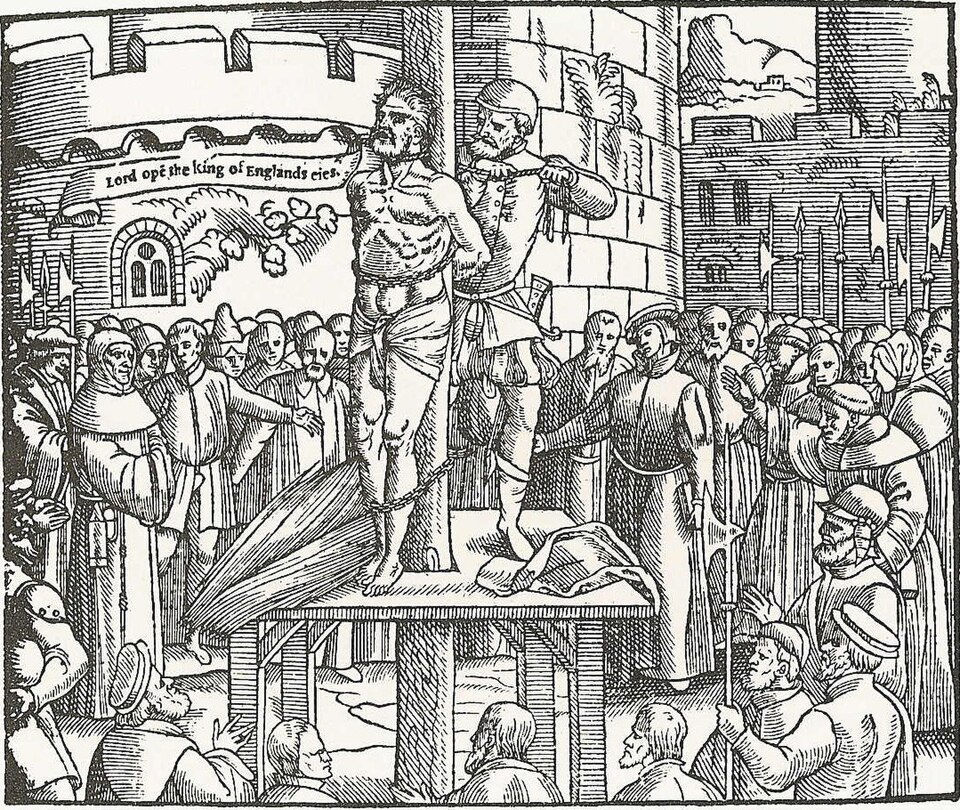
On a cold October morning in 1555, two English bishops—Hugh Latimer (1487-1555) and Nicholas Ridley (c1500-1555)—were led to the stake in Oxford. Their crime? Faithfulness to the Word of God and rejection of papal authority.
Both had served the Church of England under King Edward VI* (1537-1553), teaching salvation by grace through faith and translating the Scriptures for the people. But when “Bloody Mary” 1516-1558) ascended the throne, she sought to restore Roman Catholicism and suppress Protestant reformers.
An asterisk* after a name means the person is in my book SPIRITUAL LIVES.
Latimer, once Bishop of Worcester, was in his seventies; Ridley, Bishop of London, was in his forties. They stood side by side, chained to the same stake.
As the flames were lit, Latimer called out those immortal words to encourage his younger friend—and to bear witness that the light of the Reformation would not die with them.
Faith Tried by Fire
Their courage reminds us that truth is often costly. The Reformation was not an academic debate; it was a battle for the souls of men and women to hear God’s Word without mediation or manipulation.
Latimer and Ridley believed, as we do, that “there is one Mediator between God and man, the man Christ Jesus” (1 Timothy 2:5). They refused to recant because they had already surrendered to a greater King.
Their deaths were not in vain. The “candle” they lit in Oxford continues to shine through every open Bible, every sermon preached in the language of the people, and every believer who stands firm in faith.
Lessons for Us Today
We may not face literal flames, but the pressure to compromise truth still burns.Latimer and Ridley call us to stand fast—to speak the truth in love, to keep our consciences captive to God’s Word, and to trust that light always overcomes darkness.
“Fear not them which kill the body, but are not able to kill the soul.” — Matthew 10:28
Closing Prayer
Lord Jesus Christ,We thank You for the witness of Hugh Latimer and Nicholas Ridley,who loved not their lives unto death.Give us the same courage to hold fast the truth of Your Gospel,to live in charity, and to bear faithful witness in our own generation.May the light they lit continue to burn in our hearts,until faith becomes sight and we see You face to face.Amen.
A Glimpse Ahead: Thomas Cranmer
Standing nearby that day was another condemned man: Archbishop Thomas Cranmer, author of the first Book of Common Prayer and a principal architect of the English Reformation. Forced to watch his friends burn, he would face his own trial six months later—and ultimately recant and then recant his recantation before being burned at the same stake.
Next week we’ll tell his remarkable story of fear, repentance, and final triumph of faith in “Thomas Cranmer: The Hand that Would Not Burn.”
Closing Prayer
Lord Jesus Christ,We thank You for the witness of Hugh Latimer, Nicholas Ridley, and all who loved You more than life.Give us courage to hold fast the truth of Your Word,to speak with grace, and to stand unashamed in our generation.May the light they lit never be put out, but burn in our hearts until the day dawns and the Morning Star arises within. Amen.
The Son of God goes forth to war,
A kingly crown to gain;
His blood red banner streams afar:
Who follows in His train?
Who best can drink his cup of woe,
Triumphant over pain,
Who patient bears his cross below,
He follows in His train.
That martyr first, whose eagle eye
Could pierce beyond the grave;
Who saw his Master in the sky,
And called on Him to save.
Like Him, with pardon on His tongue,
In midst of mortal pain,
He prayed for them that did the wrong:
Who follows in His train?
A glorious band, the chosen few
On whom the Spirit came;
Twelve valiant saints, their hope they knew,
And mocked the cross and flame.
They met the tyrant’s brandished steel,
The lion’s gory mane;
They bowed their heads the death to feel:
Who follows in their train?
A noble army, men and boys,
The matron and the maid,
Around the Savior’s throne rejoice,
In robes of light arrayed.
They climbed the steep ascent of Heav’n,
Through peril, toil and pain;
O God, to us may grace be given,
To follow in their train.
Words: Reginald Heber, 1812.
They were stoned, they were sawn asunder, were tempted, were slain with the sword: they wandered about in sheepskins and goatskins; being destitute, afflicted, tormented;
(Of whom the world was not worthy:) they wandered in deserts, and in mountains, and in dens and caves of the earth.
And these all, having obtained a good report through faith, received not the promise:
God having provided some better thing for us, that they without us should not be made perfect.
Hebrews 11:37-40


Comments