


God at Work in History (6): When God Turns Defeat into Victory — Joshua 8
There are times when failure seems to have stopped everything.
Israel had crossed the Jordan. Jericho had fallen. The people had seen the power of God. Then came Ai—and Israel was defeated.
Joshua 7 had revealed why. There was hidden sin in the camp. Achan had taken what God had forbidden, and the consequences had reached the whole nation.
But Joshua 8 begins with a very different word.
“Do not be afraid, nor be dismayed.” — Joshua 8:1
God was not finished with Joshua or with Israel.
Rise and Go
The Lord said to Joshua:
“Now you shall take all the people of war with you, and arise, go up to Ai.” — Joshua 8:1
There is something striking about that command.
Israel had already gone up against Ai once—and failed.
Now God tells them to go again.
But this time God gives Joshua the strategy. Israel is to set an ambush behind the city. The men of Ai will be drawn away from the city, believing that Israel is fleeing as before. Then the men waiting in ambush will rise and take the city.
Joshua follows God's instructions.
The battle unfolds exactly as God had said.
Israel draws the men of Ai away. The ambush rises. The city is taken. The army of Ai is trapped between the two forces.
And the city that had defeated Israel is now destroyed.
Joshua 8 is therefore not simply a story about Israel winning a battle.
It is a story about God restoring His people to the work He had given them to do.
The Difference Between Joshua 7 and Joshua 8
The contrast is unmistakable.
In Joshua 7, Israel went against Ai and was defeated.
In Joshua 8, Israel goes against Ai and triumphs.
But the difference is not that Israel suddenly became stronger.
The difference is that God was with them and they were following His command.
The failure at Ai had taught Israel a painful lesson. God's presence was not something to be presumed upon while His commands were ignored.
Victory could not be separated from obedience.
And yet there is also mercy here.
God did not say to Joshua, You failed once, so you are finished.
He said:
“Do not be afraid, nor be dismayed.”
Then He sent him forward.
Failure had not become the final chapter.
The Victory Is God's
The Israelites defeat Ai, but Joshua makes clear that this victory is not something they have accomplished independently.
God had given the city into their hands.
The Lord had already told Joshua:
“See, I have given into your hand the king of Ai, his people, his city, and his land.” — Joshua 8:1
That is the recurring pattern in Joshua.
God gives.
Israel obeys.
God fulfills His promise.
The people must fight, march, pursue, and act—but they must never mistake their activity for the source of their victory.
The battle belongs to God.
Then Joshua Builds an Altar
The chapter could have ended with the destruction of Ai.
It does not.
After the victory, Joshua turns the people's attention away from the battlefield and toward God.
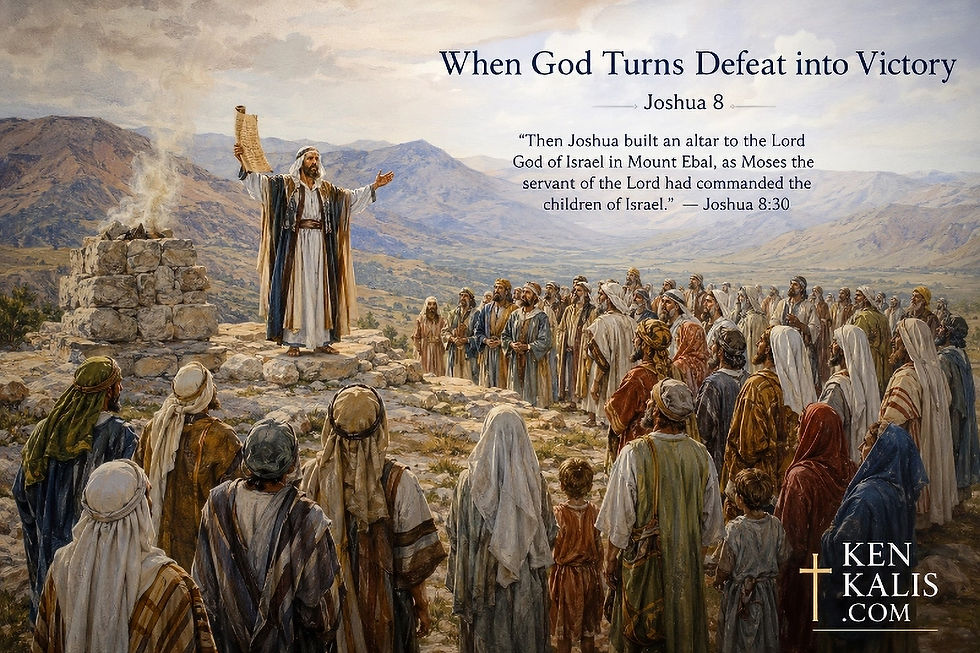
He builds an altar on Mount Ebal.
“Then Joshua built an altar to the Lord God of Israel in Mount Ebal.” — Joshua 8:30
There they offer sacrifices to the Lord.
Then Joshua writes on stones a copy of the Law of Moses.
And the entire nation gathers:
men and women, children and strangers living among them.
Joshua reads the words of the Law before all the people.
The blessings.
And the curses.
Nothing is omitted.
The people who had just experienced military victory are reminded that God's Word must remain at the center of their life together.
The lesson of Ai was not merely, Try harder next time.
It was much deeper:
Listen to God. Obey God. Trust God. Remember God.
From Defeat to Obedience
Joshua 8 gives us an important picture of how God works in history.
Sometimes God allows us to experience the consequences of disobedience.
Sometimes He exposes what has been hidden.
Sometimes He brings us through a painful defeat.
But defeat does not necessarily mean the end of the story.
Israel had fallen at Ai.
Now Israel stood victorious at Ai.
Yet the greatest moment of the chapter may not have been the victory at all.
It may have been the gathering at Mount Ebal, where the people stood together and listened to the Word of God.
Because God's purpose was never simply to make Israel victorious in battle.
He was forming a people who would live under His covenant and bear witness to His faithfulness.
God at Work in History
Joshua 8 reminds us that God is at work not only in spectacular victories but also in what follows failure.
The Lord had not abandoned Joshua.
He had not abandoned Israel.
He corrected them.
He restored them.
He gave them their next assignment.
And He brought them forward.
There is a profound difference between saying, “We failed,” and saying, “Therefore God is finished with us.”
Joshua 8 teaches us that the second conclusion does not follow from the first.
Israel's failure at Ai was real.
The consequences were real.
But God's purposes were not defeated.
He told Joshua to rise.
So Joshua rose.
He told him to go.
So Joshua went.
And God gave the victory.
That is God at work in history.
Not merely preventing every failure, but remaining faithful even when His people have failed—and calling them to rise, obey, and continue.
And at the center of it all stands the Word of God.
The God who gives victory is the God who calls His people to obedience.
The story of Joshua points beyond Joshua and Israel to the faithfulness of God Himself.
And ultimately, that faithfulness finds its fullest expression in Jesus Christ.
Our hope is not that we will never fail.
Our hope is that God is faithful.
“If we are faithless, He remains faithful; He cannot deny Himself.” — 2 Timothy 2:13
Joshua 8 is the story of a defeated people who were told to rise again.
And they did.
Because God was not finished with them.
**********************************
When through fiery trials thy pathways shall lie,
My grace, all sufficient, shall be thy supply;
The flame shall not hurt thee; I only design
Thy dross to consume, and thy gold to refine.
1787; attributed variously to John Keene, Kirkham, and John Keith.
**********************************
Come, Ye Disconsolate
Come, ye disconsolate, where’er ye languish,
Come to the mercy seat, fervently kneel.
Here bring your wounded hearts,
here tell your anguish;
Earth has no sorrow that heav’n cannot heal.
Joy of the desolate, light of the straying,
Hope of the penitent, fadeless and pure!
Here speaks the Comforter, tenderly saying,
“Earth has no sorrow that heav’n cannot cure.”
Here see the bread of life, see waters flowing
Forth from the throne of God, pure from above.
Come to the feast of love; come, ever knowing
Earth has no sorrow but heav’n can remove.
Thomas Moore, pub.1816
He healeth the broken in heart, and
bindeth up their wounds. Ps 147:3


Comments